Category: Uncategorized

  • Choosing the Right Crate for Your Miniature Bull Terrier Puppy

    A crate is one of the most useful tools you will buy for your Miniature Bull Terrier puppy, but it is also one of the easiest to get wrong. Choose a crate that is too small and your puppy cannot rest comfortably. Choose one that is too large, and you may make house training harder. Choose the wrong setup, the wrong bedding, or the wrong location, and a tool meant to create safety and routine can quickly become frustrating for both puppy and owner.

    At Legacy Mini Bull Terriers, we consider the crate part of a puppy’s education from the very beginning. Our puppies are introduced to both wire and plastic crates before they go to their homes. A crate is not simply a box with a door. It is a bedroom, a management tool, a house-training aid, a travel necessity, and, when used thoughtfully, a place where a puppy learns how to rest, settle, and feel secure.

    For first-time Miniature Bull Terrier owners especially, crate shopping can be confusing. There are wire crates, plastic airline crates, soft-sided crates, decorative furniture-style crates, travel crates, dividers, pads, mats, covers, and endless opinions online about which one is “best.” 

    Mini Wisdom: The best crate is the one that is safe, appropriately sized, easy to manage, and well suited to both the puppy in front of you and the way your household actually functions.

    Why Crate Choice Matters

    Miniature Bull Terrier puppies are sturdy, curious, determined little creatures. They can be surprisingly strong for their size, enthusiastic about chewing, and very inventive when left to their own devices. A crate needs to do more than hold a puppy for a few minutes while you answer the door. It needs to keep that puppy safe, prevent access to dangerous household items, support a predictable house-training routine, and give the puppy a place to rest without being constantly stimulated by everything happening around them.

    The crate you choose should also work for you. If it is difficult to clean, awkward to move, hard to latch securely, or so oversized that it takes over the room in a way that makes you resent using it, it is less likely to become part of a consistent routine. The goal is not to buy the fanciest crate on the market. The goal is to buy one that is practical, safe, and suited to daily life with a growing bully puppy.

    What a Crate Should Do

    Before looking at crate styles, it helps to think about what you actually need the crate to accomplish. In most homes, a puppy crate should do several things at once.

    It should provide a safe place for overnight sleep and daytime naps. It should help support house training by limiting the amount of space a puppy has when they cannot be supervised. It should offer a secure place to put the puppy when visitors arrive, when another dog needs a break, when you are carrying groceries through the door, or when you simply cannot monitor every move for the next half hour. It should also allow the puppy to begin learning an important life skill: how to settle quietly and be alone for short periods without distress.

    For many owners, the crate also becomes essential during travel (a must in the car), at dog shows, in hotel rooms, during recovery from illness or injury, or in any situation where temporary confinement is necessary. That is why we encourage owners to think beyond the first few weeks and choose a crate system that can evolve as the puppy matures.

    Mini Wisdom: We strongly recommend that Legacy puppies and dogs are crated while traveling in cars.

    The Main Types of Crates

    Wire Crates

    For most pet homes, a sturdy wire crate is the most practical starting point. Wire crates are widely available, economical, easy to clean, and offer excellent airflow and visibility. They fold flat for storage or transport, and most include divider panels that allow you to adjust the usable interior space as the puppy grows.

    That divider is important. A young puppy should have enough room to stand up, turn around, and lie down comfortably, but not so much room that one end of the crate becomes a bathroom and the other end a bedroom. A wire crate with a divider lets you buy for the adult size while still keeping the puppy’s early space appropriately limited.

    Wire crates are especially useful in busy households because puppies can still see and hear what is going on around them. That can help some puppies settle more easily, though others may need a partial cover to reduce visual stimulation. The main downside is that wire crates can encourage some puppies to paw, rattle, or mouth the bars, especially if they are overtired, under-exercised, or not yet comfortable being crated. For that reason, sturdy construction matters.

    Mini WisdomOne issue with wire crates is that they do not provide privacy for the dog, and what you use to cover or drape over the crate matters. The flimsier the material, the easier it is for the puppy to pull it in through the bars and chew or eat it. Some will do this no matter what you use; other pups will be less apt to pull and chew if the material is sturdier, such as these heavy-duty nylon ones.

    Plastic Airline-Style Crates

    Plastic crates, often called airline crates or kennel crates, are another excellent option, especially for puppies who settle better in a slightly more enclosed space. These crates offer less visual stimulation than wire crates and can feel more den-like, which some dogs prefer. They are also often used for travel and can be a good choice for car transport, overnight sleeping, or quieter rest periods.

    A well-made plastic crate can be extremely durable, but it is less flexible in terms of resizing, and it may be harder to see exactly what the puppy is doing inside. Ventilation is generally good, but not as open as with wire crates, and cleaning a major accident out of a plastic crate can be slightly more cumbersome depending on the design. Some are actually easier, because they will contain the mess.

    Still, for some households, especially those who plan to travel with their dogs or who want a second crate for quieter overnight use, a plastic crate can be a very worthwhile addition.

    Rotomolded Crates: Ruffland, Dakota 283, and Gunner Kennels

    As you start shopping for puppy supplies, you are going to come across heavier-duty crates from companies like RufflandDakota 283, and Gunner. These are not the same as the lightweight plastic airline-style crates you see in many pet stores. They are a different category of crate entirely: rotomolded kennels are built for much harder use, especially travel and vehicle transport.

    In simple terms, these kennels are made from very heavy-duty molded polyethylene and are designed to be tougher, sturdier, and more secure than a standard plastic crate. Ruffland and Dakota 283 are well-known examples of single-wall rotomolded kennels, while Gunner uses a double-wall construction that makes it even heavier and more substantial. They are built with regular travel in mind and are often used by people who show dogs in Conformation, compete in Performance events, hunt, or spend a great deal of time transporting dogs in vehicles.

    For some of you, especially if you expect to travel regularly with your dog, attend dog shows, or want a dedicated vehicle crate, these kennels may be excellent long-term investments. They are durable, easy to clean, and very practical for life on the road. If you know from the beginning that your puppy will be spending a great deal of time in the car, or if you want one crate that can transition into a more serious travel setup as the puppy matures, it is worth looking at them.

    That said, I do not want new puppy owners to assume they must go out and buy the most expensive crate on the market before bringing a puppy home. For most families, a good wire crate or a sturdy standard plastic crate is perfectly appropriate for puppyhood. What I care about most in those early months is that the crate is safe, the right size, easy for you to use consistently, and appropriate for house training, rest, and everyday management. A puppy does not need a premium travel kennel to learn to sleep through the night, settle in the house, or be safely confined for short periods during the day.

    So, my advice is to think first about how you actually plan to use the crate. If you need an indoor puppy crate for sleeping, management, and training, a wire crate or sturdy standard plastic crate is often the most practical place to start. If you know you want a serious travel crate for the car, hotel stays, dog shows, or a more permanent transport setup, then a Ruffland, Dakota, or Gunner may be worth considering either now or later.

    In other words, these are excellent crates for the right purpose, but they are not mandatory simply because you are bringing home a Miniature Bull Terrier puppy. I would rather see you buy a sensible crate you will use well than an expensive one that does not fit your actual needs.

    Metal Crates

    If you will be traveling a lot with your dog to Conformation events, a metal crate with wheels and a grooming top is incredibly helpful. I have owned Impact and East Coast Crates, and I will never buy any other than East Coast at this point. They check off all the boxes for me: sturdy, light, well-designed, great airflow, customization available including grooming top and locking wheelbase.

    They are pricey. They also do not have tons of vivid colors like some other brands, but again, for me the construction outshines competitors. For me, function is number one.

    I have had ours for decades. Consider them an investment that you will never regret. And tell Pete and Rachel Irvin, the owners, I sent you. They offer great customer service.

    Mini Wisdom: Come find me at a show and I will take you on a tour of our East Coast crate.

    Soft-Sided Crates

    Soft-sided crates are generally not a good choice for a young Miniature Bull Terrier puppy. They may be lightweight and attractive, but they are designed for dogs who are already crate trained, calm, and unlikely to chew, scratch, dig, or throw themselves against the sides. That is not the profile of most bully puppies.

    Mini Wisdom: A determined puppy can tear mesh, chew through fabric, damage zippers, ingest pieces of the crate, or collapse the structure entirely. Soft crates have their place for some adult dogs in very specific circumstances, but they are not a sensible primary crate for a baby Miniature Bull Terrier.

    Furniture-Style Crates

    Decorative crates designed to look like end tables or built-in furniture have become popular, and some are beautiful. For a fully mature, reliably calm adult dog, they may work well. For a puppy, we do not recommend them.

    Many furniture-style crates are expensive, heavy, difficult to clean thoroughly, and not built to withstand the chewing, pawing, and bodily fluids of early puppyhood. If your goal is to get through the messy, mouthy, destructive, learning-to-live-in-a-house stage successfully, practicality should come before aesthetics.

    What Size Crate Should You Buy?

    This is where many first-time owners get stuck. Miniature Bull Terriers are not a toy breed, but they are not large dogs either. A tiny puppy can look almost comically small inside the crate they will eventually use as an adult. That is why, in most cases, we recommend buying a crate sized for the adult dog and using a divider while the puppy is young.

    As a general rule, your puppy should be able to stand up without crouching, turn around easily, and lie flat in a relaxed position. They do not need a ballroom. Too much extra room can undermine house training because it makes it easier for a puppy to eliminate in one section of the crate and sleep in another.

    Many Miniature Bull Terrier owners do well with a 24-inch, 30-inch or 36-inch crate for adulthood, depending on the size and substance of the individual dog, but exact fit matters more than generic breed recommendations. The 30-inch is definitely the sweet spot for most Minis. A lighter, smaller bitch may be comfortable in one size, while a more substantial male may do better in another. If you are buying before your puppy comes home, ask your breeder what size they recommend based on the puppy’s expected adult build.

    Mini Wisdom: If I had to steer you towards one size, I would say go for 30-inch.

    Why Divider Panels Matter

    If you are using a wire crate, a divider panel is one of the most useful features you can have. It allows you to make the interior space smaller during the early house-training months and then expand it gradually as the puppy matures. This means you do not need to buy multiple crates in multiple sizes, and it makes it much easier to balance comfort with appropriate limits.

    A divider also gives you flexibility. If your puppy is having accidents in the crate, one of the first questions to ask is whether there is simply too much room. If the puppy seems cramped or uncomfortable, you can reassess and expand the space. The ability to adjust rather than start over is worth a great deal.

    One Crate or Two?

    For many families, one crate is enough. For others, two crates make life significantly easier.

    A common setup is to have one crate in the main living area for daytime naps, management, and household routine, and another in the bedroom for overnight sleep. Some owners prefer a wire crate in the daytime, public area, and a cozy plastic crate for overnight sleeping. Others use one main crate and move it as needed. There is no single right answer, but if you live in a multi-level home or expect the puppy to spend time in more than one part of the house, a second crate can be extremely useful.

    Mini Wisdom: It is also worth thinking ahead to travel. If you plan to attend dog events, stay in hotels, visit family, or transport your dog regularly, a crate that folds easily or a separate travel crate may be worth having from the start.

    Where Should the Crate Go?

    Crate placement affects how useful the crate will be and how readily the puppy accepts it. In general, a puppy’s crate should be placed somewhere that feels connected to household life but not so chaotic that the puppy can never settle.

    For daytime use, that often means a family room, kitchen, office, or other area where people spend time. Puppies tend to do better when they can see and hear their family without being in the center of every footstep and every burst of activity. 

    For overnight sleep, there are two diametrically opposite approaches. Some owners begin with the crate in the bedroom or close by, especially during the first weeks at home. That arrangement can make nighttime potty trips easier and can help a young puppy feel less abruptly isolated in a brand-new environment. 

    We place puppies at 10 weeks. They can “hold it” for a good amount of time, but not necessarily overnight. I personally do not like the puppies in my bedroom. They disturb me and I can disturb them, but every household will figure out what works for them.

    Mini Wisdom: Avoid placing the crate in direct sun, beside a heating vent, in a drafty location, or in a remote room where the puppy is essentially shut away from the family for long stretches. The crate should feel like part of the puppy’s world, not exile from it.

    What Should Go Inside the Crate?

    This is where caution matters. The crate should be comfortable, but it should not be cluttered or filled with items that create unnecessary risk. Many owners imagine a cozy crate lined with plush bedding, stuffed toys, and soft accessories. That may be lovely for a mature, trustworthy adult dog. It is not always wise for a young puppy.

    Crate Mat

    You should have a crate mat directly on the floor of the crate. Our first choice, bar none, is a Primo Pad. They are sturdy, waterproof, and fit quite snuggly, which means the pups and dogs cannot get at a corner to chew. They come in great colors, and are not cheap, but we have several that have lasted for many years and are still in perfect shape. They also make them in exact sizing for many types of kennels, so you can order the right one for your wire crate, your Ruffland, Dakota, East Coast Crate, etc. 

    Second choice is K9 Ballistics Tough Ripstop Orthopedic Crate Bed, which you can find on Amazon.

    Bedding

    Some puppies do fine with a simple washable crate pad (which is soft and goes on top of the crate mat described above). Others immediately begin chewing seams, shredding corners, pulling out stuffing, or worrying at zipper pulls and tags. If your puppy has shown any tendency to destroy bedding or ingest pieces of soft items, simplicity is safer. In some cases, no soft bedding at all until the puppy has earned it. 

    I know that sounds harsh. But take it from experience that safer is better.

    Mini Wisdom: We love K9 Ballistics Tough Ripstop Crate Pads and the Berber ones from FMS Dog Beds.

    Water in the Crate?

    Water in the crate depends on the situation. For brief crating periods, many puppies do not need it. For longer stretches, especially in an exercise pen rather than a sleep crate, water may be appropriate if it can be offered safely without creating a soaking, spilling, tipping mess. Food bowls should not live in the crate except during meals or planned chew sessions.

    Mini Wisdom: There are two main types of bowls/buckets that we use in crates. Both affix to the crate door, all of them stainless steel: check out these small round bowls or flat-sided buckets.

    How About Toys?

    As for toys, less is often more. A safe chew or food-stuffed toy can be a wonderful tool for helping a puppy settle, but random plush toys, squeakers, ropes, or anything that can be torn apart and swallowed should not be left in the crate unsupervised. Please see our article on Bully Tough, Bully Safe Toys.

    The Safety Question: What Not to Leave in a Crate

    This deserves its own section because it matters so much. A crate should contain only items you are comfortable leaving with the puppy unsupervised. If a puppy can chew it apart, swallow it, inhale it, or break it into dangerous pieces, it does not belong in the crate.

    That includes some beds, crate mats, stuffed toys, ropes, strings, collars, tags, harnesses, and anything with zippers, snaps, foam filling, or small detachable parts. Puppies have swallowed bedding, pieces of fabric, stuffing, zipper pulls, toy parts, and household objects with devastating consequences. Foreign-body obstruction, perforation, choking, and emergency surgery are not rare enough to dismiss as something that only happens in careless homes. They happen because puppies are fast, determined, and often unsupervised for just long enough.

    If your puppy is chewing or shredding what is inside the crate, do not assume it is harmless “busy work.” Reassess immediately. See our article on Zipper Surgery.

    Should You Cover the Crate?

    Sometimes. Some puppies settle better when part of the crate is covered, especially if they are visually stimulated by every movement in the room. A partial cover can create a quieter, more den-like environment and reduce barking or restlessness. Other puppies become hotter, more frustrated, or more inclined to pull the cover into the crate and chew it.

    If you use a cover, make sure airflow remains good, the puppy cannot drag the fabric through the bars, and the room temperature stays comfortable. As with most puppy equipment, the answer is not universal. Use the dog in front of you as your guide.

    The Best Crate Is the One You Will Use Correctly

    People often ask what the single best crate is for a Miniature Bull Terrier puppy, but the more useful question is what crate will work best in your home, with your puppy, and in a way that supports consistent, thoughtful use.

    A perfectly good wire crate that is used well is better than an expensive designer crate that frustrates you, overheats the puppy, or encourages unsafe bedding choices. A basic plastic crate that helps your puppy settle and sleep is better than a fashionable setup that makes daily life harder.

    Mini Wisdom: Crate choice is not about buying the most impressive piece of equipment. It is about creating a safe, practical space that supports house training, rest, management, and emotional security during a puppy’s earliest months.

    Final Thoughts

    A crate is one of the first pieces of real infrastructure you will choose for your puppy. Done thoughtfully, it becomes far more than a place to confine a dog for a little while. It becomes part of how your puppy learns routine, calm, independence, and safety.

    Choose a crate that is sturdy, appropriately sized, easy to clean, and suited to your actual household. Use a divider when needed. Keep the interior simple and safe. Resist the temptation to fill it with soft things your puppy has not earned. And remember that the goal is not merely to contain a puppy. It is to create a secure space that helps a young Miniature Bull Terrier grow into a dog who can live confidently and successfully in your home.

    Mini Wisdom: A good crate does not raise the puppy for you. But the right crate, used well, makes raising that puppy much easier.
  • Bully Tough, Bully Safe Toys

    Let’s say this right up front: the safest toys for any dog are toys that are played with under supervision. That said, we know life gets in the way, and we want to believe that dogs can be okay with a toy on their own. Individual dogs have different chewing styles, and only you will know, through observation, what works for your puppy and dog.

    If you live with a Miniature Bull Terrier, you already know that “dog toy” can be a very misleading term. Plenty of toys marketed for dogs are designed for average chewers, gentle Retrievers, or dogs who carry a plush around like a baby. That is not the Mini Bull Terrier job description.

    Mini Bulls bite hard, chew with commitment, and often approach toys as a challenge rather than a pastime. A toy that survives a Spaniel may last five minutes with a determined bully puppy. And when a toy fails, the issue is not just the mess. It is the risk of swallowed fabric, squeakers, rope strands, rubber chunks, plastic pieces, or stuffing. Please read our article on Zipper Surgery.

    So, when I talk about “bully-safe” toys, I do not mean indestructible, because no toy is truly indestructible. I mean toys that are appropriately sturdy, thoughtfully chosen, size-appropriate, and used with supervision and common sense. The goal is not to hand a puppy a random object and hope for the best. The goal is to give them safe outlets for chewing, carrying, chasing, and problem-solving without creating a veterinary emergency.

    First, the Rule That Matters Most: Know Your Dog

    There is no universal safe toy. There is only a toy that is appropriate for this dog, at this age, with this chewing style, in this situation.

    A toy that is perfectly fine for one Mini Bull may be a terrible choice for another. Some dogs gnaw. Some peel and dissect. Some try to remove every seam and spit out the carcass. Some will happily carry a soft toy around for months, while their littermate will perform open-heart surgery on it in under ten minutes.

    Mini Wisdom: Puppies also change quickly. What was safe at ten weeks may not be safe at six months. What was a supervised play toy may not be appropriate for unsupervised crate time. Owners have to pay attention to the dog in front of them, not just the label on the package.

    My Basic Toy Safety Rules for Bullies

    Before I get into categories, these are the standards I use in my own house:

    1. Bigger is usually better

    If you are deciding between two sizes, I generally lean larger. Tiny toys, miniature tennis balls, little squeaky plushies, and anything that can disappear fully into the mouth are poor choices for a bully breed puppy. I do not want toys that can be swallowed whole or torn into gulpable pieces quickly.

    2. Retire damaged toys early

    A toy does not need to be completely destroyed to become unsafe. If a seam opens, a squeaker is exposed, a rubber edge starts peeling off, or a nylon toy splinters into sharp points, it is done. Throw it away.

    3. Separate “interactive toys” from “leave-alone toys”

    Some toys are for tugging, fetching, and training sessions with you. Some are for supervised independent chewing. Very few toys should be treated as “drop this in the crate and forget about it.”

    4. Rotation beats clutter

    Most dogs do better with a smaller number of good toys rotated regularly than with a mountain of junky toys available all the time. Rotation keeps toys interesting and makes it easier for owners to notice wear and tear.

    5. Supervision matters, especially with puppies

    Puppies are creative in all the wrong ways. The first several times a new toy is offered, I want to see exactly how the puppy interacts with it. Does she chew appropriately? Try to swallow it? Shred it? Strip off pieces? Fall asleep with it? That tells me whether the toy stays in rotation or gets removed.

    What I Like for Miniature Bull Terriers

    Durable rubber toys for chewing and stuffing

    This is one of my favorite categories for bully puppies and adults because it can do several jobs at once. A good heavy rubber toy, like the classic Kong, can satisfy chewing needs, slow down eating, occupy a busy brain, and help a puppy settle in a crate or x-pen.

    These stuffable rubber toys that can be filled with part of a meal, a smear of something puppy-safe, or a few pieces of kibble. For many puppies, these become far more valuable than random plush toys because they reward licking, chewing, and working instead of frantic destruction.

    What I like:

    • Thick, reputable rubber from established dog-toy brands, like Kong
    • More choices: WEST PAW Zogoflex Echo Zwig,
    • Check out RuffDawg’s Dawg-Nut donut shapes and the Maxx and the Tastee Choo from Choobee.
    • Shapes large enough that the dog cannot fit the entire toy deep into the back of the mouth
    • Toys that can be stuffed, frozen, and washed easily
    • Rubber that flexes slightly rather than feeling brittle or thin

    What I avoid:

    • Cheap rubber toys with a strong chemical smell
    • Toys with glued-on decorations, plastic eyes, or weak seams
    • Very small rubber toys sold for “small dogs” that are not appropriate for a bully jaw

    Harder chew toys, used thoughtfully

    Some bully owners do well with sturdy chew toys made of dense nylon, wood-alternative composites, or other hard materials. These can be useful for dogs who truly need to work their jaws. But I use more caution here than many people do.

    A chew toy should not be so hard that I worry about teeth. There is a difference between durable and brick-like. Aggressive chewers can crack premolars and molars on items that are simply too hard. I also do not want sharp edges or splintering surfaces.

    If I use harder chew toys, I inspect them constantly and match them to the dog’s chewing style. A dog who calmly gnaws may do well with them. A dog who slams down and tries to fracture the toy may not.

    Mini Wisdom: I know that wood sounds like an off choice, but coffee wood dog toys work well in many Mini households. Also check out Nylabone and Benebone brands for good choices. You will quickly learn what shapes your dog likes; for some reason, Nora and her kids love the wishbone shapes!

    Balls that are too large to swallow and tough enough for supervised play

    Mini Bulls often love chase games, but ball choice matters. I do not like tiny tennis balls for bully puppies, and I am not a fan of flimsy squeaky balls that collapse into shards. I prefer balls that are:

    • Appropriately oversized
    • Made for strong chewers
    • Smooth enough not to shred instantly
    • Used under supervision, especially if the dog’s goal is to sit and methodically destroy the ball rather than retrieve it

    A ball for fetch is not automatically a ball for unsupervised chewing.

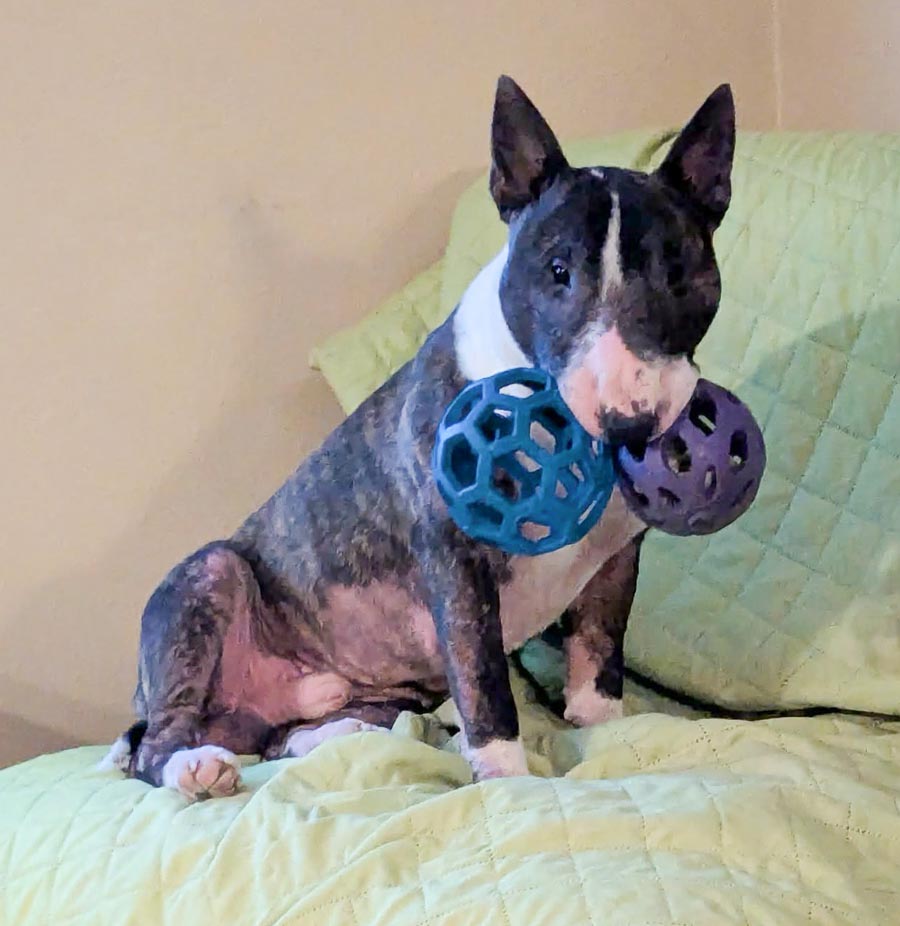
    Check out: Chew King by Mammoth Fetch Ball and Jolly BallAn exception in design is the JW Pet HOL-ee Roller™, Dog Toy Puzzle Ball, and the Petmate Crackle Heads Ball, which some dogs love. Funny story, I knew one dog who had a red HOL-ee Roller and a blue one. He went for the red one every single time.

    Mini Wisdom: If you find that your dog is very ball-focused–and some are–beware that they may repeatedly nudge it around, which can lead to a banged-up nose area. Just keep an eye out for obsessive play and use.

    Tug toys for interactive play

    Tug is a wonderful outlet for many MBTs when it is done with structure. A sturdy tug toy can give a puppy an appropriate target for grabbing and pulling and can be a great way to channel intensity into a game with rules.

    For tug toys, I look for:

    • Durable construction
    • Comfortable length so hands are not too close to teeth
    • Materials that do not unravel immediately

    But tug toys are people toys in my house, not toys I leave lying around all day for puppies to dissect. Be wary of ones made from rope or braided fleece. They can work, but only with supervision and get rid of them the moment they start to unravel.

    Mini Wisdom: Look into Goughnuts Heavy-Duty Tug Toy.

    Natural Bones

    We love natural bones and there are a few that we recommend.

    Firstly, if you have a high-quality butcher nearby and can buy marrow bones, they can be a great treat. I remove most of the marrow, as your dog does not need all that fat.

    I also love the cold-smoked beef marrow bones by Mika & Sammy’s Gourmet Pet Treats

    Natural Hair-On Hide Rolls

    Ugly Chews and Farm Hounds make hair-on natural hide rolls that are not the same as “rawhide” chews you might find in a pet store, which are heavily processed and often treated with harsh chemicals. The inexpensive, commercial type are made only from the inner layer of the hide, after the outer portion has been removed for leather production. The result is a chew that dogs can soften, tear apart, and swallow much more quickly, which can increase the risk of choking or intestinal blockage. These are different, but we still suggest use under supervision.

    The first time you see the hair-on rolls, you might be a bit shocked, but most dogs love them and the hair is digestible and very beneficial to the digestive tract (think of it like a pipe cleaner). It also delivers good levels of fiber and manganese, according to Farm Hounds. They are also quite long lasting.

    Mini Wisdom: Take the time to read the brands’ websites; they have a lot of information on how to choose size and how to safely offer them to your pup or dog.

    Fleece or soft “stuffy” comfort items for the right puppy

    This is where people sometimes expect a universal rule from me and do not get one. Some puppies are perfectly capable of having a soft comfort toy. Others absolutely cannot be trusted with one.

    If a puppy gently carries a plush, naps with it, or mouths it without trying to excavate the stuffing, a soft toy may be fine as a supervised comfort item. If the puppy’s life mission is to remove the eyes, open the seams, and consume the squeaker, then no, that puppy does not get plush toys.

    Mini Wisdom: I do not assume that because something is sold in the pet aisle it is safe for a bully puppy. Plush is a privilege, not a right.

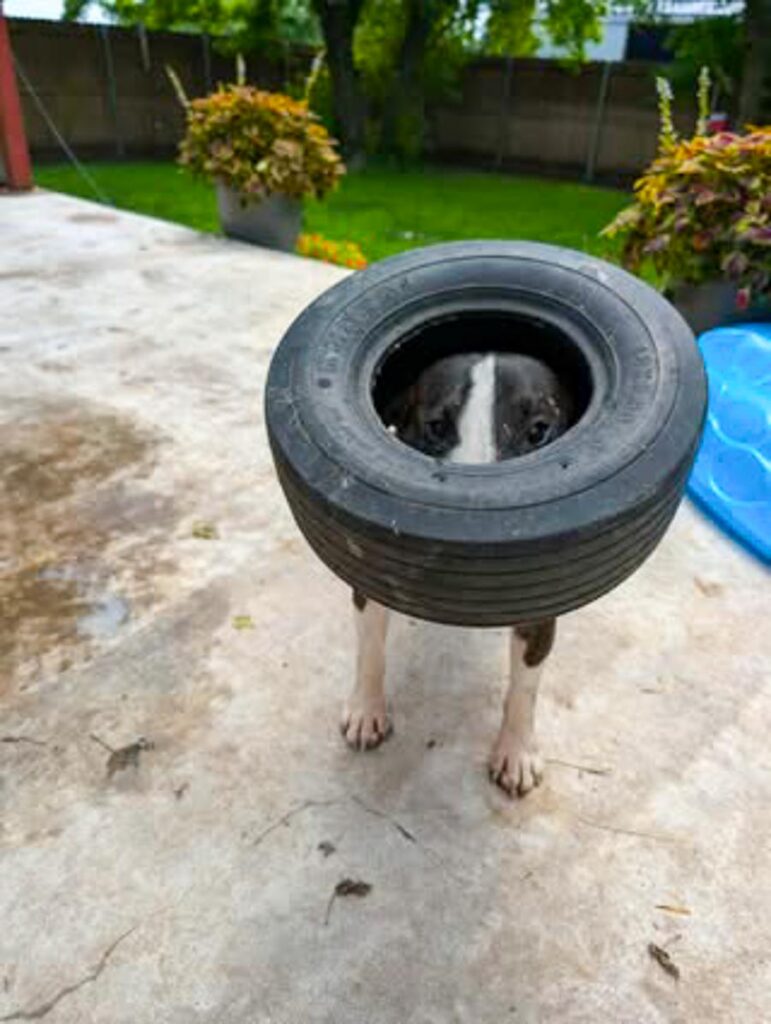
    Tires

    Yes, tires. Some folks use smaller tires as play/chew toys. Here you can see a lawn mower tire getting a workout.

    What I Am Cautious About

    Rope toys

    Rope toys are extremely popular, and I understand why. Dogs love them. They are easy to throw, easy to tug, and often inexpensive. But for a dog who shreds and ingests fibers, rope makes me nervous.

    Long strings swallowed from rope toys can create serious gastrointestinal problems. If I use rope at all, it is for closely supervised interaction, and I retire it the moment it begins to fray. I do not leave shredded rope toys in a crate and call it enrichment.

    Antlers, bones, hooves, and ultra-hard natural chews

    Some owners swear by these. I am more conservative. My concern is tooth damage, breakage, and in some cases digestive upset or gulping risks. Mini Bulls are enthusiastic enough without being handed a tooth-cracking project.

    Toys with glued parts, plastic trim, or easy-to-remove accessories

    If it has little ears, ribbons, hard plastic eyes, bells, pom-poms, or decorative nonsense, it is probably not coming into my house for a bully puppy. I want clean, simple construction.

    Anything already half-destroyed

    This sounds obvious, but people keep toys far longer than they should. A “favorite toy” with an open seam and stuffing hanging out is not sentimental. It is a problem.

    Crate Toys Need Their Own Standards

    Owners often ask what can go in the crate. My answer is: fewer things than you think.

    Crate time is not the place for a pile of random toys. If I am leaving a puppy or dog with something, I want it to be something I know well, have already observed, and trust for that specific puppy/dog. Often that means a thoughtfully chosen rubber stuffable toy or, depending on the dog, nothing at all beyond safe bedding if bedding is appropriate for that puppy.

    I do not recommend loading a crate with plush toys, rope toys, or anything a puppy has already shown an interest in shredding.

    Mini Wisdom: I always run my hands through my dog’s crate bedding. They are known to take toys into their “den” and hide them for later, and it might be a toy I do not want them to have unsupervised.

    Toy Safety Is Also About Teaching

    One of the best things owners can do is actively teach toy habits instead of just tossing toys on the floor and hoping for the best.

    Use toys to:

    • Redirect biting onto appropriate objects
    • Reward calm crate time
    • Build retrieve and tug games with rules
    • Create positive downtime after exercise
    • Reinforce that hands, clothes, leashes, and crate bedding are not chew toys

    Bullies do best when we do not leave them to invent their own entertainment.

    My Bottom Line on Bully-Safe Toys

    If you own a Miniature Bull Terrier, buy toys with a healthy amount of skepticism. Ignore cute marketing and think like a risk manager. Ask:

    • Is it large enough?
    • Is it durable enough for my dog?
    • What happens if this starts to fail? Is there a choking or obstruction hazard?
    • Can I supervise it appropriately?
    • Is this a toy for active play, chewing, comfort, or crate time?
    • Has my puppy already shown me she cannot be trusted with this type of material?

    Mini Wisdom: There is no perfect toy. But there are much better choices and much worse ones.

  • A Serious Note on Ingestion Risks and “Zipper Surgery”

    One of the reasons we are so emphatic about crates, pens, gates, and careful space management is that puppies do not simply chew inappropriate items. Some puppies swallow them, and the consequences can be catastrophic.

    Miniature Bull Terrier puppies are curious, physical, bold, and often astonishingly determined. They investigate the world with their mouths, and they are frequently faster, stronger, and more inventive than first-time owners expect. And even seasoned owners are often astonished at their speed and cleverness. What begins as ordinary puppy mischief can turn into a life-threatening emergency in minutes. Puppies can choke on objects that obstruct the airway. They can swallow items that become lodged in the stomach or intestines, causing obstruction, perforation, poisoning, internal injury, sepsis, emergency surgery, and death.

    This is not theoretical. Puppies have swallowed earbuds, batteries, pen caps and entire pens, dental picks, socks, underwear, children’s toys, stuffing from beds and plush toys, zipper pulls, rocks, string, pieces of leashes, remote controls, and household items no one imagined they could reach. They can bite into light bulbs. They can shatter and ingest pieces of glass Christmas ornaments. They can chew through a bag, a drawer, or a bedside table item and swallow what they find. They can grab something off a counter, out of a purse, from a nightstand, from the laundry, or from the trash before anyone has time to react.

    Batteries are particularly dangerous because they can do more than obstruct. They can burn tissue, leak corrosive material, and cause devastating injury very quickly. Sharp objects such as dental picks, broken plastic, pen parts, or fragments of glass can tear tissue and perforate the digestive tract. Soft items are not automatically safer. Fabric, bedding, rope fibers, socks, toy stuffing, and pieces of crate mats can wad up inside the gastrointestinal tract and create an obstruction that cuts off normal passage, compromises blood supply, and requires emergency surgery. A swallowed object does not have to be large to be lethal.

    This is why we urge owners to stop thinking only in terms of “what might get chewed” and start thinking in terms of “what could be swallowed, inhaled, or broken into dangerous pieces.” A puppy’s environment should be evaluated with that question in mind every single day. 

    If an item can be reached, grabbed, torn apart, punctured, crushed, swallowed, inhaled, or broken into shards, it should not be accessible to a young puppy. That includes the obvious things, like socks and children’s toys, but it also includes the less obvious ones: earbuds, charging cords, batteries, pens, dental tools, medication bottles, remote controls, decorative objects, holiday ornaments, handbags, and anything left within reach on a table, counter edge, or open shelf.

    The phrase “zipper surgery” may sound casual, but there is nothing casual about the reality behind it. Foreign-body surgery is expensive, painful, risky, and frightening. Even when a puppy survives, recovery can be difficult. And not every puppy does survive. Some die from choking before they can reach a veterinarian. Some die from perforation, toxicity, or complications after an obstruction has already caused significant damage.

    This is why space management matters so much. It is why crates should be thoughtfully set up, why puppy pens should contain only safe and appropriate items, why floors and low tables should be kept clear, why purses and backpacks should not be left where a puppy can reach them, and why unsupervised freedom should be granted slowly and carefully. Good management is not fussy, overprotective, or excessive. It is one of the most important ways you can protect a young dog from a preventable emergency.

    When people hear breeders talk about management, they sometimes think we are talking about chewed shoes or damaged furniture. We are not. We are also talking about keeping a puppy alive.

  • Crates, Pens, and Space Management: Setting a Miniature Bull Terrier Puppy Up for Success

    Bringing home a Miniature Bull Terrier puppy is exciting, funny, chaotic, and occasionally a little humbling. One minute you are admiring that sturdy little body and egg-shaped head, and the next you are fishing a sock out of the puppy’s mouth while trying to remember where you left the baby gate. Miniature Bull Terrier puppies are curious, energetic, physical, and often deeply committed to exploring the world with their teeth. That does not make them difficult puppies. It makes them puppies, and very typical bully puppies at that.

    One of the best ways to help a young Mini succeed is to manage the environment thoughtfully from the very beginning. Crates, exercise pens, gates, and designated puppy-safe spaces are not signs that you expect trouble. They are tools that make good habits easier to build. They protect the puppy from making unsafe choices, protect your home and belongings from unnecessary damage, and protect your sanity during the months when supervision must be active and consistent.

    At Legacy Mini Bull Terriers, we believe that space management is one of the most underappreciated parts of puppy raising. A well-managed puppy is not being restricted for the sake of control. A well-managed puppy is being set up to learn, rest, regulate, and succeed.

    Why Space Management Matters So Much With a Miniature Bull Terrier Puppy

    Miniature Bull Terrier puppies are bright, busy, and physically capable little creatures. They are often more confident than they are wise, which is part of their charm and part of why management matters so much. Given too much freedom too early, many puppies will make exactly the kinds of choices you would expect from an athletic baby with no impulse control: chewing a table leg, grabbing a shoe, racing through the house with a dish towel, harassing an older dog, or having an accident in the one room you forgot to close off.

    None of that means the puppy is stubborn, dominant, or intentionally “bad.” It simply means the puppy has been given more opportunity than judgment. Young puppies do not come home already knowing where to nap, what to chew, how to settle, when to go outside, or which rooms are off limits. All of those things must be taught. Management tools bridge the gap between what a puppy wants to do in the moment and what you are trying to teach for the long term.

    A crate or pen cannot teach manners on its own, but it can prevent a great many rehearsals of the wrong behavior while you are teaching the right one.

    Mini Wisdom: All Legacy puppies will have spent time in crates, and we will not place a dog in a house without one. You do not need prior crate experience, but you do need to be willing to continue the crate training when you bring your dog home.

    Think of Management as Training Support, Not Puppy Jail

    Some new owners worry that using a crate or exercise pen is unkind or overly restrictive. In reality, good space management is one of the kindest things you can do for a young puppy. Puppies need sleep, routine, and relief from constant stimulation just as much as they need play and affection. A well-set-up crate or pen gives them a safe place to decompress, chew something appropriate, nap without interruption, and learn that being alone for short periods is not frightening.

    The goal is not to put the puppy away all day. The goal is to create a rhythm that includes supervised freedom, training, outdoor potty trips, play, rest, and calm down time. Puppies who are overtired or overstimulated often become mouthier, wilder, and less able to make good choices. In many cases, what looks like “bad behavior” is really a tired puppy who needs help settling.

    A structured environment makes it easier for a puppy to succeed because it removes the expectation that a baby dog should manage freedom as if he were already an adult.

    Mini Wisdom: We have owned dogs that never outgrew their need to be crated when unsupervised. It is impossible to predict how trustworthy these dogs are at the age of placement with families. The house and they were simply not safe without containment.

    The Crate: A Safe Resting Place and a House-Training Tool

    A crate is one of the most useful tools in early puppy raising when it is introduced thoughtfully and used as part of a positive routine. The crate should function as a bedroom, not a punishment box. It is a place where the puppy can sleep safely, rest after play, eat a chew, and learn to be calm when direct supervision is not possible.

    Crates are especially helpful with house training because puppies are often reluctant to soil the place where they sleep, provided the crate is appropriately sized. That does not mean a puppy can “hold it” for long stretches simply because he is crated. Young puppies need frequent trips outside, especially after waking, eating, drinking, playing, and training. We also potty break before playing and training. The crate helps create structure, but it is not a substitute for taking the puppy out often and rewarding him for getting it right.

    For many families, the crate is also a sanity-saving overnight tool. It keeps the puppy safe, prevents midnight wandering, and helps establish a predictable bedtime routine. Some puppies settle quickly in a crate at night; others need a more gradual introduction with the crate near the bed at first. Either approach can work as long as the puppy is supported through the transition.

    Mini Wisdom: Please see our Sidebar below on Zipper Surgery.

    “Zipper Surgery” Can End in Tragedy

    Miniature Bull Terrier puppies can die from swallowing the wrong object. A zipper pull, piece of bedding, crate mat, sock, string, earbud, battery, pen, dental pick, or children’s toy can obstruct the airway, block the stomach or intestines, poison, perforate, or otherwise catastrophically injure a puppy in minutes.

    The phrase “zipper surgery” may sound almost casual, but the reality is not. If an item can be chewed apart, swallowed, inhaled, or broken into dangerous pieces, it does not belong in a puppy’s space.

    The phrase “zipper surgery” comes from the fact that some dogs have had to undergo repeat surgeries, and since they need to be opened up again, owners are fond of saying, “Too bad they don’t have zippers.” But this is no joke; it is a moment of dark humor.

    It is not hyperbole to say that as owners, it is our job to prevent these occurrences that WILL happen without the proper supervision.

    Choosing the Right Crate

    For most Miniature Bull Terrier puppies, a wire crate or sturdy airline-style sturdy plastic crate works well. The most important thing is that the crate be safe, well-ventilated, and appropriately sized. Your puppy should be able to stand up, turn around, and lie down comfortably, but the crate should not be so large that one end becomes a bedroom and the other a bathroom.

    If you purchase a crate that will eventually fit the puppy as an adult, a divider panel can be useful in the early months, so the interior space does not overwhelm the puppy. Soft-sided crates are generally not ideal for a young bully puppy who is still in the chewing, pawing, and flinging-himself-against-things stage of life. Personally, I do not use them for adults, either.

    Where you place the crate matters too. In many homes, it helps to keep one crate in the main living area so the puppy can rest while still feeling included, and another in the bedroom if you prefer a separate sleeping setup at night. The exact arrangement matters less than the routine and the puppy’s sense that the crate is a familiar, predictable part of daily life.

    Using the Crate Without Creating Drama

    A crate should never feel like a sudden disappearance from all things fun. The easiest way to build a good association is to make the crate part of pleasant routines from day one. Some owners feed meals in the crate (I do not unless on the road in a hotel room with multiple dogs to manage). Toss treats in and let the puppy walk in to find them. Offer a stuffed food toy or safe chew in the crate while you sit nearby. Let the puppy enter, enjoy something good, and come back out again before building toward longer stretches.

    Your Legacy puppy will have already had these experiences. You just need to continue the training.

    A puppy who has just exercised, gone to the bathroom, had a little training, and been given a chew is in a much better position to settle than a puppy who has been dropped into a crate with too much energy and no preparation. Context matters.

    Mini Wisdom: Please read our article on Choosing Crates. There are many on the market, some more appropriate for a Mini than others.

    The Exercise Pen: Freedom With Boundaries

    If the crate is the puppy’s bedroom, the exercise pen is often the playroom. An x-pen gives a puppy more room to move around, chew a toy, stretch out, and interact with the household without having unrestricted access to every chair leg and electrical cord in sight. For many families, an exercise pen is one of the most useful puppy tools in the house.

    Pens work especially well during the day when you are nearby but cannot actively supervise every second. You might set up a pen in the kitchen while you cook dinner, in the office while you work, or in the living room while the family watches television. Inside the pen, the puppy can have a bed, a water bowl if appropriate for the length of time, a safe chew, and a few toys without the pressure of navigating the entire house.

    For a Miniature Bull Terrier puppy, a pen can be invaluable during the mouthy, busy, overtired stage of life. It creates a middle ground between full freedom and full confinement. It also makes it much easier to interrupt bad habits before they become established. A puppy in a pen cannot disappear behind the sofa to shred a magazine or steal a child’s toy from the playroom. That alone is worth a great deal.

    Mini WisdomWe have several x-pens; all are at least 36-inches tall. They fold up easily and are easy to have tucked away in the rooms where you might need to set them up at a moment’s notice.

    Creating a Puppy Zone in Your Home

    In addition to crates and pens, most homes benefit from a designated puppy-safe area. This might be a gated kitchen, a section of the family room, or another easy-to-clean space where the puppy can spend time under close supervision. Ideally, the area should be free of dangling cords, houseplants, fragile objects, shoes, and anything small enough to swallow or interesting enough to destroy.

    The point of a puppy zone is not simply to contain chaos. It is to create a space where the puppy can practice being in the home without being set up to fail. If the puppy has access only to safe items and appropriate chew objects, you are far more likely to catch and reinforce good choices. That matters. Every time a puppy chooses a toy instead of a baseboard, or settles on a mat instead of launching at the coffee table, you have an opportunity to quietly strengthen the behavior you want.

    Mini Wisdom: As your puppy matures and shows reliability, the puppy zone can gradually expand. But that freedom should be earned in small, realistic steps, not granted all at once because the puppy looked especially adorable after breakfast.

    Baby Gates Are Not Optional Luxury Items

    One of the simplest and most effective puppy tools in the house is the baby gate. Gates allow you to limit access without physically isolating the puppy from the family. They can keep a puppy out of carpeted bedrooms during house training, block off staircases, separate dogs during mealtimes, or create a calm space when the puppy is too wound up to make good decisions in the middle of household traffic.

    For first-time owners, gates are often easier to use consistently than closing doors because they let the puppy see what is happening without barging into every scene. They are also invaluable when you need to protect an older dog’s space, keep the puppy away from children’s toys, or create a buffer around the front door during busy arrivals and departures.

    Mini Wisdom: In many homes, gates become part of the daily rhythm long after puppyhood. They are one of those humble management tools that quietly make life easier.

    Preventing the Most Common Puppy Mistakes

    Good space management helps prevent several of the problems that frustrate new owners most.

    • House-training accidents: A loose puppy who wanders out of sight is a puppy who may choose a quiet corner to relieve himself. Keeping the puppy in a crate, pen, or gated area when you cannot supervise closely makes accidents easier to prevent and patterns easier to establish.
    • Destructive chewing: Puppies chew because they are teething, exploring, bored, tired, curious, or simply because chewing feels good. If they have access to rugs, shoes, furniture, cords, and laundry baskets, they will often choose those things. Management dramatically reduces the opportunity.
    • Overstimulation and wild behavior: Many puppies become frantic not because they need more freedom, but because they need less stimulation and more structure. A pen or crate can help a puppy come back down when the household has become too exciting.
    • Harassing older dogs: Even tolerant adult dogs deserve a break from puppy enthusiasm. Gates, pens, and crates allow puppies and adult dogs to coexist more peacefully by ensuring that no one has to be “on” all the time.
    • Practicing bad habits: Every time a puppy races through the house stealing socks, launching onto furniture, or grabbing the hem of your pants, he is practicing a behavior that may become more ingrained. Preventing those rehearsals is easier than undoing them later.

    How Much Freedom Is Too Much?

    This is one of the most common questions new owners ask, and the honest answer is that it depends on the puppy. Some Miniature Bull Terrier puppies mature into thoughtful little citizens fairly quickly. Others remain inventive, mouthy opportunists for quite a while. The right amount of freedom is not determined by age alone but by behavior.

    A puppy is ready for more space when he is consistently making good choices in the space he already has. Is he reliably asking to go out or staying clean between potty trips? Is he choosing appropriate chew items? Can he settle for short periods without inventing trouble? Can he be redirected easily when excited? If the answer is yes, you can begin to expand access gradually.

    Mini Wisdom: Gradual is the key word. A puppy who has done beautifully in the kitchen for two weeks does not necessarily need immediate access to the entire first floor. Add one room, supervise carefully, and see how he handles it. Freedom should grow alongside judgment.

    Management Should Support Training, Not Replace It

    It is important to say this clearly: crates, pens, and gates do not teach behavior by themselves. They create the conditions in which good behavior is easier to teach. Your puppy still needs training, socialization, structure, exercise, sleep, and patient repetition.

    If you want a puppy who settles calmly in the house, you still have to reward calm behavior. If you want a puppy who walks nicely on leash, waits politely for meals, comes when called, and leaves your sleeves alone, those skills still need to be taught. Management prevents chaos from becoming the puppy’s default hobby while you are doing that teaching.

    Mini Wisdom: Used well, management is not a shortcut. It is part of the foundation. Read the title again; space management is not the same as training.

    What We Want a Legacy Puppy to Learn

    When a Legacy puppy comes home, our hope is not simply that he avoids chewing the coffee table. We want him to learn how to live successfully in a home. That means learning to rest, to self-soothe, to be alone for short periods, to settle after excitement, to chew appropriate items, to accept routine, and to feel safe within household structure.

    Crates, pens, and thoughtful space management support all of those lessons. They help create predictability, and predictability helps puppies feel secure. Over time, that structure becomes freedom, because a puppy who has been taught well and managed well grows into an adult dog who can handle more of the world with confidence and good judgment.

    Mini Wisdom: The time you put in with your puppy will reap rewards for the rest of your life together.

    Final Thoughts

    Miniature Bull Terrier puppies are funny, physical, affectionate little bulldozers. They bring energy, joy, curiosity, and a healthy respect for household rules they did not personally approve. Setting them up for success does not mean hovering nervously over every move. It means building an environment that supports good choices while they are still learning how to make them.

    A crate is not a punishment. A pen is not a failure. A baby gate is not an admission that your puppy is difficult. These are simply tools, and when used thoughtfully, they make puppy raising calmer, clearer, and far more successful for everyone involved.

    In the early months, management is not separate from training. It is one of the ways good training begins.

  • 10 Things to Know Before Bringing Home a Miniature Bull Terrier Puppy

    Bringing home a Miniature Bull Terrier puppy is equal parts joy, comedy, and commitment. These dogs are charming, clever, affectionate, and endlessly entertaining, but they are not low-maintenance little companions who quietly fit themselves into your life. A Miniature Bull Terrier arrives with opinions, energy, curiosity, and a remarkable talent for turning ordinary household moments into full-contact participation sports.

    At Legacy Mini Bull Terriers, we believe that the best puppy homes are built on honest expectations. A well-bred Miniature Bull Terrier can be an extraordinary companion, but this breed thrives when owners understand from the start what life with one really looks like. If you are considering adding a Miniature Bull Terrier puppy to your family, here are ten things we hope you know before that homecoming day arrives.

    1. A Miniature Bull Terrier Is a Lot of Dog in a Small Package

    The word miniature can be misleading. While the Miniature Bull Terrier is smaller than the Bull Terrier, it is not a delicate lapdog or an easy “small breed” in the way many people imagine. Minis are muscular, athletic, determined, and surprisingly strong for their size. They tend to move through the world with confidence and intensity, and they often bring a very big personality into a relatively compact body.

    That combination is part of what makes them so endearing. It is also why they do best with owners who appreciate a dog that is fully engaged with life. A Miniature Bull Terrier puppy will not be content to simply decorate your sofa (although they are very good at this, too). This is a breed that wants to investigate, play, train, chew, learn, and be part of whatever is happening in the house. If you are looking for a quiet, undemanding companion, this may not be the right breed. If you are looking for a small but substantial dog with humor, substance, and heart, the Miniature Bull Terrier can be very hard to resist.

    Mini Wisdom: Their strength should not be underestimated. As with Bull Terriers, you might learn the hard way that leaning over an exuberant puppy will lead to a head bonk to your nose that can prove not only painful, but possibly needing medical attention. Watch your shins, too.

    2. They Need More Than Physical Exercise

    One of the most common mistakes new owners make is assuming that a tired puppy is simply a puppy who has had enough physical activity. Exercise matters, of course, but with Miniature Bull Terriers, mental engagement is just as important. These are bright, busy dogs who can become mischievous if they are under-stimulated. A walk around the block is helpful, but it is rarely the whole answer.

    Miniature Bull Terrier puppies benefit from short training sessions, enrichment toys, food puzzles, supervised exploration, confidence-building outings, and opportunities to learn how to settle as well as how to play. The goal is not to keep a puppy constantly entertained, but to provide a balanced routine that includes movement, learning, rest, and structure. A puppy who is given appropriate outlets for curiosity and problem-solving is often easier to live with than one who is simply run harder and harder in the hope of “wearing him out.”

    Mini Wisdom: While certain enrichment toys are wonderful, how they are received by your Mini might be different from what you have heard with other Minis. Case in point: Nora and her siblings were given a puzzle toy, filled with treats. They all gathered around, excited at the prospect of something new that smelled like food. As her siblings were trying to figure out how to get the food from within, Nora walked over, picked up the toy, and tossed it in the air so that all the food came tumbling out as it landed. In other words, this was a fantastic toy for Nora for about 10 seconds. Different dogs need different toys.

    3. They Are Funny, Affectionate, and Often Intensely Involved in Your Life

    People are drawn to Miniature Bull Terriers for many reasons, but temperament is near the top of the list. This breed is often comical, expressive, and deeply attached to its people. Minis have a way of making themselves central to the household. They do not merely live alongside their families; they participate in everything. They want to know what you are doing, where you are going, and whether they have been consulted about it. They will be in the bathroom with you (every time). They will stand between you and the sink as you do dishes. Some find your time on the phone an insult as it is time taken away from them and will try mightily to get your attention. When you get up to go to another room to get your phone/hair tie/sneakers/notebook, they follow. Because. You moved and they want to be with you.

    That closeness is one of the great joys of the breed. It also means they are not always ideal for people who want a very independent dog. Many Miniature Bull Terriers thrive on companionship and routine. They like being near their people, and puppies in particular need thoughtful guidance in learning how to be alone comfortably for short periods. Teaching independence gently, through crate training, structured down time, and predictable routines, is part of raising a stable, confident companion.

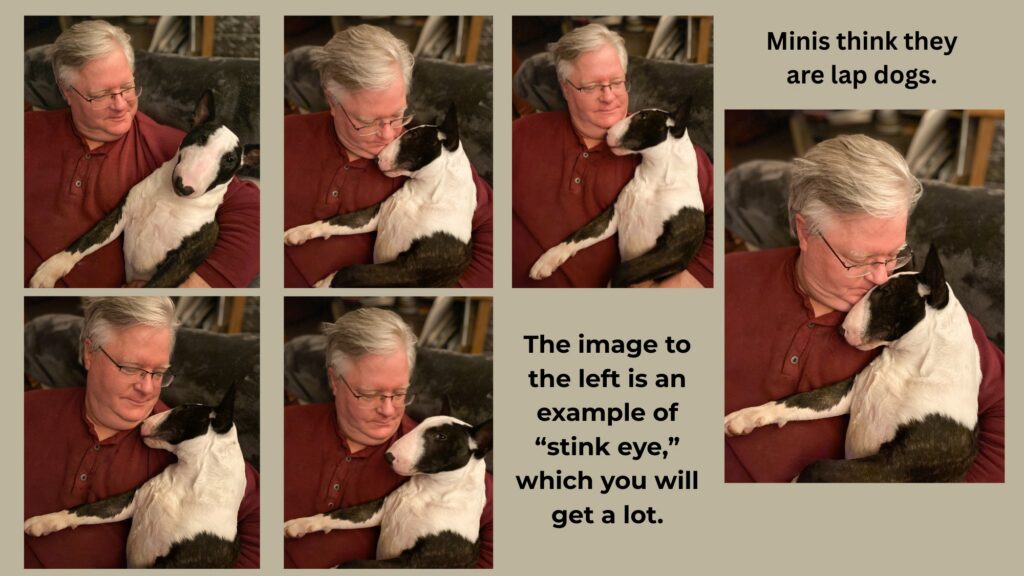
    Mini Wisdom: When we say, “near you,” we actually mean they will very often be “on” you. Sitting on your foot. Leaning against your leg. Climbing on your head and shoulders. You must be okay with giving up personal space.

    4. Puppy Biting, Chewing, and General Chaos Are Normal

    Miniature Bull Terrier puppies are adorable. They are also land sharks with opinions. Like many terrier puppies, they explore the world with their mouths, and they can be enthusiastic chewers, nippers, and thieves of household objects. This does not mean the puppy is “bad.” It means you have a puppy, and management matters.

    Before your puppy comes home, it helps to think like a toddler-proofing specialist. Shoes, charging cords, children’s toys, remote controls, eyeglasses, rugs, and anything sentimental or swallowable should be picked up or blocked off. A good crate, exercise pen, baby gates, safe chew options, and a plan for supervision are essential. The first months are not the time to assume a puppy will make wise choices if simply given freedom. Puppies need thoughtful management while they are learning what belongs to them, what does not, and how to regulate their own excitement.

    Mini Wisdom: While the puppy biting phase is expected, it must be addressed appropriately and at the right time. Your Breeder can help immeasurably here. Don’t hesitate to reach out.

    5. Consistency Matters More Than Harshness

    Miniature Bull Terriers are strong-minded, but that does not mean they respond well to force or heavy-handed correction. In our experience, they do best with calm, clear, consistent training that begins early and is reinforced often. A puppy does not need a harsh owner. A puppy needs a fair one.

    This breed thrives when house rules are simple and predictable. If the puppy is not allowed on furniture, that needs to be true every day, not only when muddy paws become inconvenient. If the puppy is expected to wait at doors, settle in a crate, or walk politely on leash, those skills need to be taught patiently and practiced regularly. Miniature Bull Terriers are often smart enough to spot inconsistency almost immediately. The more coherent your expectations are, the easier life tends to become for both dog and owner.

    Mini Wisdom: We have yet to meet a Miniature Bull Terrier who has not, at some point, exercised the right to ignore a perfectly reasonable request. Minis are very smart, but intelligence and biddability are not the same thing. A biddable dog is eager to comply simply because you asked. Minis tend to be a bit more selective. They are often willing to cooperate when your idea also happens to feel like their idea.

    That independent streak is part of the breed’s charm, but it does require perspective. A Mini may absolutely understand “get off the chair” or “stop chewing my sweater sleeve” and still pause to consider whether compliance is really in everyone’s best interest. Depending on your personality, this will either make you laugh or test your patience. Usually, it does a little of both. Living with a Miniature Bull Terrier often means accepting that training is not just about teaching cues. It is also about consistency, timing, and learning how to negotiate with a very clever dog who has strong opinions of their own.

    6. Socialization Should Build Confidence, Not Overwhelm

    A well-socialized puppy is not a puppy who has been dragged through every store, festival, and family gathering in the first eight weeks of ownership. Good socialization is more thoughtful than that. It is about helping a young dog feel safe and competent in the world by introducing new sights, sounds, surfaces, people, and experiences in a way that builds confidence rather than stress. 

    For a Miniature Bull Terrier puppy, this might mean meeting friendly adults, hearing household noises, walking on different textures, riding in the car, visiting the veterinary office for happy, low-pressure check-ins, and learning that novelty is not frightening. It should also include learning to recover from mild frustration, to settle after excitement, and to look to the owner for guidance. Socialization is not a race. The goal is not exposure for its own sake; it is resilience, curiosity, and trust.

    Mini Wisdom: Note that “socialization” does not mean running around loose at a dog park with dogs that you have no control over, or knowledge of. 

    7. Adolescence Is Real, and It Can Be Hilarious and Maddening

    Many people are prepared for the sleepless early puppy stage. Fewer are prepared for adolescence. Somewhere between babyhood and adulthood, your delightful puppy may test boundaries, become conveniently deaf, rediscover chewing, and temporarily forget skills he appeared to know last week. This is not unique to Miniature Bull Terriers, but their determination and sense of humor can make the phase feel especially memorable.

    Adolescence is when consistency pays off. It is also when many owners benefit from staying engaged with training classes, structured activities, and breeder support. This is not the time to assume the dog is “grown up” and no longer needs guidance. The habits you reinforce during adolescence often shape the adult dog you live with for years to come. Patience, routine, and a sense of humor go a long way.

    Mini Wisdom: We highly encourage classes, of all kinds. There are early classes, like Star Puppy and local Puppy Kindergarten classes, but you can also look into intro classes to Scent Work, Rally, and so much more. Just coordinate and communicate with your Breeder and vet to see what is appropriate per your dog’s age.

    8. A Good Breeder Is Part of the Puppy Package

    A Miniature Bull Terrier puppy should never be treated like a product purchased and taken home with no further relationship attached. A responsible breeder does much more than produce a litter. A breeder should be evaluating health, temperament, structure, and suitability; raising the puppies with care; beginning socialization and enrichment; and remaining available as a resource long after pickup day.

    At Legacy Mini Bull Terriers, we believe that every puppy is an individual, and every placement should be made with the long view in mind. That is why we ask questions, why we take matching seriously, and why we remain committed to our puppies throughout their lives. A good breeder wants to know how the puppy is doing, wants to help when questions arise, and wants the dog to have the right home. If a breeder is unwilling to answer questions about health and genetic testing, temperament, puppy raising, contracts, or long-term support, our sincere suggestion is to find another breeder.

    Mini Wisdom: Take a look at our Videos page and Instagram to see many videos depicting how we raise litters at Legacy.

    9. Health Matters, and So Does Understanding What Health Testing Really Means

    One of the most important things a puppy buyer can do is learn what responsible health testing looks like in the Miniature Bull Terrier. This breed has known health concerns, and no thoughtful breeder should pretend otherwise. Health and genetic testing is not about producing guarantees that nothing will ever go wrong. It is about using the best available tools to make informed breeding decisions and to reduce avoidable risk.

    A responsible Miniature Bull Terrier breeder should be able to discuss the testing performed on breeding dogs and explain why those tests matter. Depending on the dog and the breeding program, that may include BAER hearing evaluation, cardiac screening, kidney evaluation, patella assessment, eye examinations, and relevant DNA testing for known inherited conditions. Just as important, a breeder should be honest about what testing can and cannot tell us. Genetics is one piece of the puzzle. So are family history, longevity, temperament, structure, and a breeder’s willingness to follow dogs over time and learn from every generation.

    Mini Wisdom: Please read our article Health Testing Is Just the Beginning: Understanding Genetics in the Miniature Bull Terrier.

    10. The Right Match Matters More Than Getting a Puppy Quickly

    When people fall in love with a breed, it is natural to want a puppy as soon as possible. But with Miniature Bull Terriers, as with any breed, the goal should not simply be getting a puppy. It should be finding the right puppy, from the right breeding program, at the right time, for the right home.

    That may mean joining a waiting list. It may mean having a thoughtful conversation about your schedule, household, experience, goals, and expectations. It may mean hearing that a particular litter—or even a particular breed—is not the best fit for what you want. Good breeders do not ask questions to be difficult. They ask because they are trying to make the best lifelong match possible for both puppy and family.

    A Miniature Bull Terrier can be a wonderful companion for the right home: funny, loyal, athletic, affectionate, and unmistakably full of personality. But success with this breed starts long before pickup day. It begins with understanding what you are bringing home, what the breed needs from you, and what kind of life you want to build together.

    Mini Wisdom: You can take a look at our Puppy Inquiry to see the questions we begin with that help us determine if a Legacy puppy and you are a great match.

    Final Thoughts

    A Miniature Bull Terrier puppy should bring delight into your life, but delight is only part of the picture. These puppies also require patience, structure, supervision, training, and a willingness to live with a dog who will almost certainly keep you on your toes. They are clever, engaging little powerhouses with a strong sense of self and a tremendous capacity for companionship.

    For the right family, that combination is exactly the point.

    At Legacy Mini Bull Terriers, we believe that informed puppy buyers make the best puppy owners. If you are considering a Miniature Bull Terrier and want to learn more about the breed, our puppy process, or how we approach matching puppies to homes, we invite you to get in touch. Bringing home a puppy is the beginning of a long relationship, and it is one worth starting thoughtfully.

  • Health Testing Is Just the Beginning: Understanding Genetics in the Miniature Bull Terrier

    Responsible breeding has always been about far more than producing beautiful dogs. Every breeding decision carries with it the opportunity—and the responsibility—to preserve the Miniature Bull Terrier for future generations.

    Today’s breeders have more tools available than ever before. DNA testing, advanced cardiac imaging, kidney screening, hearing evaluations, and public health databases allow us to make breeding decisions that were unimaginable only a few decades ago.

    Yet those tools are only as valuable as our understanding of them.

    Health testing is not simply a checklist to complete before a litter. It is part of an ongoing commitment to understanding genetics, evaluating individual dogs honestly, and making thoughtful breeding decisions that balance health, temperament, type, and genetic diversity.

    Genetics Is Probability, Not Perfection

    One of the biggest misconceptions among puppy buyers—and sometimes newer breeders—is that a “clear” health test means a dog is genetically perfect.

    It doesn’t.

    Some diseases are caused by a single known mutation and can be identified through DNA testing. Others are polygenic, meaning multiple genes—and often environmental factors—play a role. Some conditions have no reliable DNA test at all.

    Health testing reduces risk. It does not eliminate it.

    Likewise, producing an affected puppy does not necessarily mean someone was careless. Responsible breeders can only work with the information science currently provides, while continuing to monitor the health of their dogs and their offspring throughout their lives.

    DNA Tests: Powerful—but Limited

    DNA testing has revolutionized breeding, particularly for diseases inherited in a simple recessive pattern.

    For Miniature Bull Terriers, the most important DNA tests include:

    • Primary Lens Luxation (PLL) 
    • Lethal Acrodermatitis (LAD) 
    • Laryngeal Paralysis (LP) 

    These tests identify whether a dog is:

    • Clear 
    • Carrier 
    • Affected/At Risk (depending on the disease) 

    Understanding these results is critical.

    A carrier is not a sick dog.

    In fact, carriers are often completely healthy throughout their lives. The genetic mutation becomes important only when selecting breeding partners.

    For recessive diseases like PLL and LAD, breeding a carrier to a clear dog will not produce affected puppies. Removing every carrier from breeding would unnecessarily reduce the breed’s already limited gene pool, potentially creating new problems while trying to solve existing ones. Instead, responsible breeders use DNA information strategically to avoid producing affected puppies while preserving valuable bloodlines. 

    Heart Disease Requires More Than a Stethoscope

    Heart disease remains one of the breed’s most important health concerns.

    Many congenital abnormalities cannot be reliably detected through auscultation (by stethoscope) alone. While listening with a stethoscope is valuable, subtle valve abnormalities or blood-flow disturbances may only become apparent during advanced imaging.

    For this reason, the Miniature Bull Terrier Club of American (MBTCA) recommends that breeding dogs undergo evaluation by a board-certified veterinary cardiologist using echocardiography with color Doppler. This examination provides a far more complete assessment of cardiac structure and blood flow than a routine physical examination alone. 

    Cardiac screening should not be viewed as a one-time event. Because some conditions develop or progress with age, periodic re-evaluation provides the most meaningful information for breeding decisions.

    The first echocardiography with color Doppler should be performed at the age of two.

    Kidney Disease: The Silent Threat

    Kidney disease has long been a concern within Bull Terriers and Miniature Bull Terriers.

    Hereditary nephritis (HN) and polycystic kidney disease (PKD) often progress quietly. Dogs may appear completely healthy while irreversible damage is occurring.

    Routine urine Protein:Creatinine Ratio (UPC) testing can identify abnormal protein loss that may indicate hereditary nephritis long before clinical illness develops.

    Ultrasound examination remains the preferred method for identifying polycystic kidney disease.

    Because kidney disease often develops gradually, annual screening provides far more useful information than a single normal result obtained early in life. 

    Hearing Matters

    Congenital deafness affects both Bull Terriers and Miniature Bull Terriers.

    Although it occurs more frequently in predominantly white dogs, colored dogs can also be affected.

    The only reliable method of determining hearing status is the Brainstem Auditory Evoked Response (BAER) test.

    BAER testing objectively measures hearing in each ear independently. Puppies are generally tested after five weeks of age, allowing breeders to identify unilateral or bilateral deafness before placement. The results become a permanent part of the dog’s health record and help guide future breeding decisions. 

    Don’t Forget Structure

    Not every inherited condition can be identified through DNA.

    Orthopedic evaluations remain important because sound structure contributes directly to lifelong function.

    Patellar luxation continues to be an important screening recommendation for Miniature Bull Terriers. 

    These evaluations help breeders make more informed decisions while contributing valuable information to breed-wide health databases. 

    Eyes Need More Than DNA

    DNA testing for Primary Lens Luxation (PLL) provides valuable information for breeding decisions, but it is only one aspect of maintaining good eye health. Regular veterinary examinations allow your veterinarian to monitor your dog’s eyes as part of routine wellness care and determine if additional evaluation is needed.

    No Dog Is Perfect

    Perhaps the most important lesson genetics teaches us is humility.

    Every Miniature Bull Terrier carries genes we understand and genes we do not. Every breeding represents a balance of strengths and weaknesses.

    Responsible breeding is not about finding the mythical “perfect” dog. It is about making informed decisions that improve the next generation while protecting the genetic diversity the breed needs to remain healthy.

    Health testing should never be viewed as a marketing tool or a badge of superiority. It is simply one of the responsibilities we accept when we choose to breed.

    Looking Forward

    The future of the Miniature Bull Terrier depends on breeders who embrace both science and stewardship.

    As new DNA tests become available and our understanding of inherited disease continues to expand, breeders will gain even more powerful tools. But no laboratory result can replace honest evaluation, lifelong follow-up of offspring, mentorship, and the willingness to share information openly.

    Health testing is not the finish line. It is the foundation upon which responsible breeding is built.

    When combined with sound temperament, correct breed type, functional structure, and thoughtful selection of breeding pairs, these tools help ensure that future generations of Miniature Bull Terriers are not only beautiful representatives of the breed—but healthier ones as well.

  • Living With a Miniature Bull Terrier Puppy: What to Expect

    Small Dog, Big Personality—and a Whole Lot of Puppy in a Compact Package

    People are often drawn to Miniature Bull Terriers because of their distinctive appearance. The egg-shaped head, mischievous expression, and compact size make them unforgettable. What photographs cannot fully convey, however, is the personality that comes with the package.

    Miniature Bull Terriers are intelligent, entertaining, affectionate, and full of confidence. They are also energetic, determined, and sometimes delightfully stubborn (well, not delightful for everyone; more on that below). Living with a Miniature Bull Terrier puppy can be one of life’s greatest joys, but it helps to know what to expect before bringing one home.

    They Are Full of Energy

    Miniature Bull Terrier puppies approach life with enthusiasm. For many, everything is an adventure. Every leaf, toy, squirrel, visitor, and household object deserves investigation.

    While they are not hyperactive dogs, they are active and engaged. Puppies need daily physical exercise, mental stimulation, and opportunities to interact with their families. A bored Miniature Bull Terrier puppy will often find ways to entertain itself, and you may not always appreciate its creativity; they will become destructive.

    An important note here is that certain lines of Minis are more active than others. And certain individuals are more active (mentally and physically) than others. At Legacy, we deliberately breed for stable, calmer, temperaments. That said, there will always be a variety of temperaments within a litter, and we take care to match the right dog with the right home. This is why it is important to fill out our Puppy Inquiry and tell us as much about you as possible.

    They Are Smart Thinkers

    These puppies learn quickly, but they are not always eager to follow instructions simply because you ask.

    Below is the video we submitted for Nora’s Novice Trick Title (her TKN); she is 12 weeks old in the video:

    Miniature Bull Terriers are problem solvers. They respond best to positive, consistent training that makes learning enjoyable. Harsh methods rarely produce good results. Building a strong relationship based on trust, structure, and clear expectations will take you much farther than trying to dominate them.

    They Want to Be Part of the Family

    Miniature Bull Terriers are people-oriented dogs. They thrive when included in everyday life and generally do not enjoy being isolated from their families for long periods.

    Most puppies want to know what you are doing, where you are going, and whether they can come along. Many become devoted companions who follow their people from room to room and happily participate in family activities. (Yes, they will find accompanying you to the bathroom every time to be a necessary action).

    They Can Be Comical

    One of the breed’s most endearing qualities is its sense of humor.

    Owners often describe Miniature Bull Terriers as clowns. They have a knack for making people laugh with their expressions, antics, and unique approach to life. Many Minis seem convinced that the world exists for their entertainment.

    Living with a Miniature Bull Terrier often means sharing your home with a comedian who never takes a day off.

    This is where that stubborn comment comes in. They hear you asking them to get off the chair. They know what you are asking. They just might think that lounging there and staring you down, or completely ignoring you, is hilarious, and/or they just don’t “feel” like following your suggestion. Funny? Can be. Frustrating? Can be. A lot of patience and humor will be required on your part. If this does not sound like fun to you, then a Mini might not be the right breed.

    Early Training Matters

    Like all puppies, Miniature Bull Terriers benefit from early socialization and training.

    We Follow Puppy Culture

    Puppy Culture is a program designed to help every puppy become the best dog they can be. Through early neurological stimulation, exposure to new people, places, sounds, surfaces, and experiences, it helps puppies develop into confident adults. We work very hard at laying a foundation for a well-adjusted companion.

    We encourage all of our puppy owners to buy the With Open Arms and Level Head Puppy Culture program, long before they bring their puppy home.

    They Need Boundaries

    MBT’s confidence and intelligence are wonderful traits, but they can also lead puppies to test limits.

    Miniature Bull Terriers do best when expectations are clear and consistent. Family members should agree on household rules and apply them fairly. Puppies who understand what is expected tend to become more reliable and easier to live with as they mature.

    They Mature Into Loyal Companions

    While puppyhood can be busy, the rewards are considerable.

    A well-raised Miniature Bull Terrier will grows into a devoted companion with a remarkable sense of humor, a loving nature, and a strong bond with its family. They are equally happy joining you on adventures or relaxing at home after a day of activity.

    For the right home, few breeds offer the same combination of personality, intelligence, affection, and fun.

    Is a Miniature Bull Terrier Right for You?

    The best homes for Miniature Bull Terrier puppies are those that embrace the breed for what it is: active, engaging, intelligent, occasionally stubborn, endlessly entertaining, and deeply devoted.

    If you are looking for a dog with a big personality in a compact package, a Miniature Bull Terrier may be exactly what you have been searching for.

  • What Is a Preservation Breeder?

    If you’re searching for a Miniature Bull Terrier puppy, you’ve probably come across the term “preservation breeder” or “ethical breeder.” But what do these actually mean?

    At its heart, preservation breeding is about protecting the future of the breed—not simply producing puppies.

    A preservation breeder is committed to maintaining and improving the Miniature Bull Terrier by carefully selecting breeding dogs that exemplify the breed’s correct structure, sound temperament, health, and type. Every breeding is thoughtfully planned with future generations in mind, guided by the AKC Breed Standard and a deep understanding of pedigrees, genetics, and the history of the breed.

    For preservation breeders, every litter has a purpose. The goal is never quantity. It is quality.

    The image is of Ngoc and Freeman Wilson, the day they picked up Dora, Legacy & Old Forge Red Carpet Ready, from Nora’s first litter.

    Freeman has been in the breeds for his whole life.

    More Than Health Testing

    Health and genetic testing is an essential part of responsible breeding, but preservation breeding goes much further.

    A preservation breeder studies generations of dogs—not only their health, but also their temperaments, longevity, movement, and consistency. We look at strengths and weaknesses throughout a pedigree and strive to produce puppies that are healthier, sounder, and more representative of the breed than the generation before.

    Health testing helps us make informed breeding decisions, but experience, mentorship, and decades of learning are equally important.

    Preserving What Makes a Miniature Bull Terrier

    The Miniature Bull Terrier is unlike any other breed. Their unmistakable egg-shaped head, keen expression, sturdy build, clownish personality, intelligence, confidence, and devotion to their families all combine to create a truly unique dog.

    Preservation breeders work to protect those defining characteristics. We do not breed simply for unusual colors, novelty, or what’s fashionable at the moment. Trends come and go, but the breed itself deserves to remain true to the qualities that generations of dedicated breeders have worked so hard to preserve.

    Every Puppy Matters

    A preservation breeder doesn’t breed often. Because each litter represents years of planning, puppies are raised with great care from the moment they are born. Early neurological stimulation, thoughtful socialization, proper nutrition, exposure to everyday life, and careful evaluation of temperament all help prepare each puppy for a successful future.

    Just as important is matching the right puppy with the right family. Every Miniature Bull Terrier is an individual, and no two puppies are exactly alike. Finding the best lifelong home for each puppy is one of the breeder’s greatest responsibilities.

    A Lifetime Commitment

    For preservation breeders, responsibility does not end when a puppy goes home.

    We remain a resource throughout the dog’s life, answering questions, offering guidance, celebrating accomplishments, and helping owners navigate challenges. Every puppy we produce will always have a place to return if circumstances change.

    Our commitment is not simply to our puppy buyers—it is to every dog we bring into the world.

    Our Philosophy at Legacy

    Legacy Miniature Bull Terriers is built on the belief that preservation breeding is both a privilege and a responsibility. As a third-generation Bull Terrier family, we are dedicated to protecting this remarkable breed through thoughtful planning, comprehensive health testing, careful attention to structure and temperament, and lifelong support for every puppy and family.

    Our goal is not simply to breed Miniature Bull Terriers. Our goal is to help ensure that future generations will know and love the same healthy, sound, intelligent, and unmistakably joyful Miniature Bull Terriers that have inspired us for decades.

    Legacy Mini Bull Terriers logo
  • The Breed Standard

    An AKC Breed Standard is the official blueprint that describes the ideal specimen of a breed, in this case, the Miniature Bull Terrier. Developed and maintained by each breed’s Parent Club (the MBTCA, in our case) and approved by the American Kennel Club, the Standard outlines the physical structure, movement, temperament, and overall characteristics that define the breed and preserve its purpose.

    Breed Standards are not simply descriptions of appearance, and temperament. They serve as a guide for breeders making breeding decisions, judges evaluating dogs in the Conformation ring, and enthusiasts seeking to understand the qualities that make each breed unique. Every word in a Standard has meaning, reflecting generations of careful selection and the traits considered essential to the breed’s identity, function, and long-term preservation.

    The goal is not perfection, as no perfect Mini exists, but a shared vision of the breed at its best. By understanding and applying the Breed Standard, breeders and judges help ensure that future generations continue to embody the characteristics that distinguish the breed and honor its history.

    In the dog world, phrases such as “well-bred,” “correct type,” or “not to standard” are rooted in the Breed Standard. The standard establishes the ideal characteristics of the Miniature Bull Terrier and provides a common framework for evaluating breeding stock, show dogs, and the breed as a whole, including color, coat texture, and temperament.

    Official Standard of the Miniature Bull Terrier

    General Appearance: The Miniature Bull Terrier must be strongly built, symmetrical and active, with a keen, determined and intelligent expression. He should be full of fire, having a courageous, even temperament and be amenable to discipline.

    Size, Proportion, Substance: Miniature Bull Terriers should be of correct size, compact, strongly built, with maximum bone and substance for their size while at all times appearing balanced. In proportion, the Miniature Bull Terrier should give the appearance of being just off square, measuring from breastbone to rear of thigh – slightly longer than tall. Height 10 to 14 inches as measured from the withers to the ground.

    Head: The head should be long, strong and deep, right to the end of the muzzle, but not coarse. The full face should be oval in outline and be filled completely up, giving the impression of fullness with a surface devoid of hollows or indentations, i.e., egg shaped. The profile should curve gently downwards from the top of the skull to the tip of the nose. The top of the skull should be flat across from ear to ear. The distance from the tip of the nose to the eyes should be perceptibly greater than that from the eyes to the top of the skull. The underjaw should be deep and well defined. To achieve a keen, determined, and intelligent expression, the eyes should be well sunken and as dark as possible with a piercing glint. They should be small, dark, triangular and obliquely placed, set high up on the dog’s head, placed closer to the ears than to the nose. Blue eyes are a disqualification. The ears should be small, thin, and placed close together, capable of being held stiffly erect. The nose should be black, and bent downwards at the tip. The lips should be clean and tight. The teeth should meet in either a level or scissor bite with correctly placed canines. The teeth should be sound, strong and perfectly regular. While correct dentition is desirable, it should never be considered more important than the traits of the breed outlined in this standard.

    Neck, Topline, Body: The neck should be very muscular, long, and arched; tapering from the shoulders to the head, it should be free from loose skin. The back should be short and strong with a slight arch over the loin. Behind the shoulders there should be no slackness or dip at the withers. The body should be well rounded with marked spring of rib and short coupled. The chest should be broad when viewed from the front. There should be great depth from withers to brisket, so that the latter is nearer to the ground than the belly. The underline, from the brisket to the belly, should form a graceful upward curve. The tail should be short, set on just below topline, and carried horizontally. It should be thick where it joins the body and should taper to a fine point.

    Forequarters: The shoulders should be strong and muscular, but without heaviness. The shoulder blades/scapula should be laid back and approximately the same length as the upper arm/humerus. When viewed from the side the elbow should be directly below the highest point of the shoulder. The legs should be big boned but not to the point of coarseness. The forelegs should be of moderate length, perfectly straight, and the dog must stand firmly upon them. The elbows must turn neither in nor out, and the pasterns should be strong and upright. The feet are round and compact with well-arched toes like a cat.

    Hindquarters: The hind legs should be parallel when viewed from behind. The thigh and second thigh are very muscular and well-developed. The stifle joint and hock are well angulated with hind pasterns short and upright. The feet are round and compact with well arched toes like a cat.

    Coat: The coat should be straight, short, flat and harsh to the touch with a fine gloss. The dog’s skin should fit tightly.

    Color: For white, pure white coat. Markings on head and skin pigmentation are not to be penalized. For colored, any allowed color to predominate. Allowed colors: Brindle, Black Brindle, Black and Tan, Red, Fawn – With or without white and/or smut markings. Any other color is a disqualification.

    Gait: The dog shall move smoothly, covering the ground with free, easy strides, Fore and hind legs should move parallel to each other when viewed from in front or behind, with the forelegs reaching out well and the hind legs moving smoothly at the hip and flexing well at the stifle and hock. The dog should move compactly and in one piece but with a typical jaunty air that suggests agility and power.

    Temperament: The temperament should be full of fire and courageous, but even and amenable to discipline.

    Faults: Any departure from the foregoing points shall be considered a fault, and the seriousness of the fault shall be in exact proportion to its degree.

    Disqualifications:

    Blue eyes.

    Any color other than allowed.

    Approved January 13, 2026

    Effective April 1, 2026

    A Note on Color and Coat

    Prospective puppy buyers should be wary of breeders advertising “rare” or “exotic” colors such as Merle, Lilac, Chocolate, Liver, Isabella, or Lavender. You might even see “Fluffy” “Minis.” These colors are not part of the established Miniature Bull Terrier gene pool and are not recognized by the Breed Standard. Put simply: These are not Miniature Bull Terriers. They literally cannot be Minis.

    Producing such colors and textures requires introducing genetic material from other breeds, placing color above breed preservation. Responsible preservation breeders prioritize health, temperament, structure, and breed type rather than novelty or market-driven trends.

    Some of these dogs are sold with AKC papers, but that can only mean that the parents were registered illegally, and someone lied when registering them. Please do not support these unscrupulous breeders.

    Exotic Colors Have Health Related Concerns

    merle and fluffy, but not Mini

    The dogs above were created by AI for demonstration purposes.

    Beyond concerns about breed purity and preservation, some of the genes responsible for so-called “exotic” colors are associated with health risks. The Merle gene, for example, can cause serious problems when two Merle dogs are bred together, including deafness, vision defects, and other developmental abnormalities. Merle introduces a gene that has never been part of the traditional Miniature Bull Terrier gene pool.

    Extreme dilution colors, often marketed as Lilac, Lavender, or Isabella, may also be associated with Color Dilution Alopecia (CDA), a condition that can cause hair thinning, patchy coat loss, and recurring skin problems. While not every dilute-colored dog develops CDA, the risk is well documented in several breeds where dilution genes are present.

    These health concerns illustrate why responsible breeders focus on preserving the breed’s established colors and characteristics rather than pursuing novelty. The goal of preservation breeding is to produce healthy, sound Miniature Bull Terriers that conform to the Breed Standard, not to create rare colors that may compromise the breed’s long-term welfare.

    Here is our cheat sheet:

    • If a breeder uses the terms “exotic” or “rare,” steer clear.
    • “Minis” advertised as the following ARE NOT PURE MINIATURE BULL TERRIERS, and in our opinion, should not be labeled and sold as MBTs.
      • Merle (any Merle, such as Blue Merle, Red Merle, etc.)
      • Blue
      • Blue Fawn
      • Liver
      • Lilac
      • Isabella
      • Lavender
      • Chocolate
      • Tri-Merle or Tri-Merle combinations
      • Platinum
      • Champagne
      • Fluffy, or any coat texture other than as described in the Breed Standard
    • Note that unscrupulous breeders will try to sell you a “Mini” that is not only not a Mini but also charge exorbitant prices.
    • A note on Recessive vs. Dominant genes: While it is theoretically possible for a recessive color gene to remain hidden for generations, there is no documented evidence that the liver (chocolate) gene was historically part of the Miniature Bull Terrier gene pool. Preservation Breeders generally regard liver as a non-traditional color whose appearance raises questions about the breed’s genetic history. Unlike recessive colors, the Merle gene is dominant and cannot remain hidden indefinitely, which is why claims that Merle has always existed in the breed are viewed with particular skepticism.
    • We have seen language on websites such as the following. These descriptions represent a lack of understanding of the Miniature Bull Terrier, and we do not support this kind of breeding. This language is a strong cue to move on and find a reputable breeder, such as one listed on the MBTCA Breeder List.
      • “Today, this color variety appeals to families seeking a dynamic companion with a distinctive appearance… This variation represents a modern aesthetic development bred primarily in the United States and Europe over recent decades.”
      • “Eyes may even range from traditional brown to striking blue, adding an extra touch of distinction.”

    Mini Bull Type

    Here we have some drawings showing correct and incorrect Conformation. This is not just about a dog “looking good.” Poor Conformation – structure – can also lead to health issues, such as when you have weak pasterns or other skeletal issues.

    Head Type
    Fill and Stop
    Eye and Ear placement
    Neck Topline Withers
    Incorrect topline
    Tail set
    Front assembly
    faults