
An AKC Breed Standard is the official blueprint that describes the ideal specimen of a breed, in this case, the Miniature Bull Terrier. Developed and maintained by each breed’s Parent Club (the MBTCA, in our case) and approved by the American Kennel Club, the Standard outlines the physical structure, movement, temperament, and overall characteristics that define the breed and preserve its purpose.
Breed Standards are not simply descriptions of appearance, and temperament. They serve as a guide for breeders making breeding decisions, judges evaluating dogs in the Conformation ring, and enthusiasts seeking to understand the qualities that make each breed unique. Every word in a Standard has meaning, reflecting generations of careful selection and the traits considered essential to the breed’s identity, function, and long-term preservation.
The goal is not perfection, as no perfect Mini exists, but a shared vision of the breed at its best. By understanding and applying the Breed Standard, breeders and judges help ensure that future generations continue to embody the characteristics that distinguish the breed and honor its history.
In the dog world, phrases such as “well-bred,” “correct type,” or “not to standard” are rooted in the Breed Standard. The standard establishes the ideal characteristics of the Miniature Bull Terrier and provides a common framework for evaluating breeding stock, show dogs, and the breed as a whole, including color, coat texture, and temperament.
Official Standard of the Miniature Bull Terrier
General Appearance: The Miniature Bull Terrier must be strongly built, symmetrical and active, with a keen, determined and intelligent expression. He should be full of fire, having a courageous, even temperament and be amenable to discipline.
Size, Proportion, Substance: Miniature Bull Terriers should be of correct size, compact, strongly built, with maximum bone and substance for their size while at all times appearing balanced. In proportion, the Miniature Bull Terrier should give the appearance of being just off square, measuring from breastbone to rear of thigh – slightly longer than tall. Height 10 to 14 inches as measured from the withers to the ground.
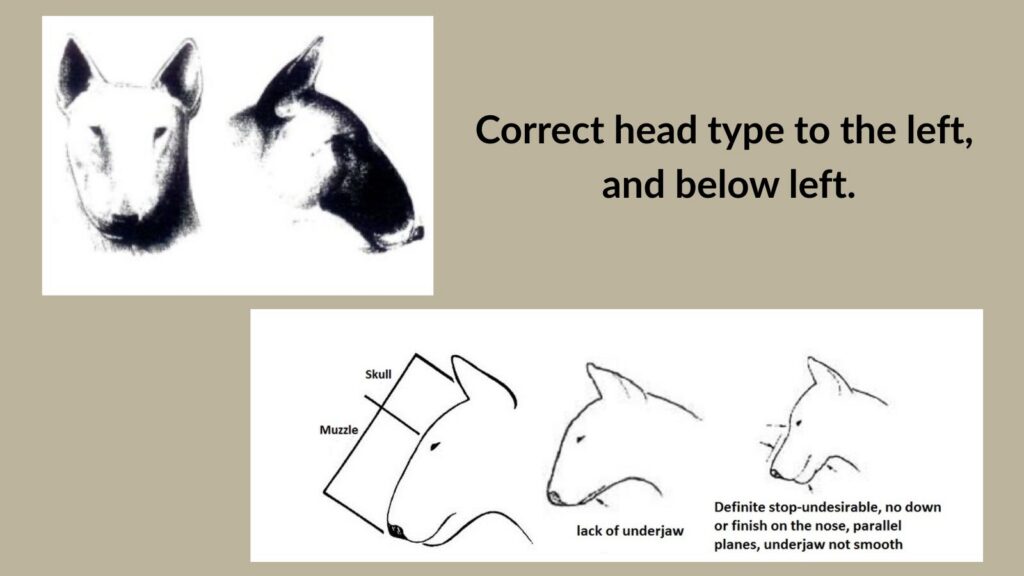
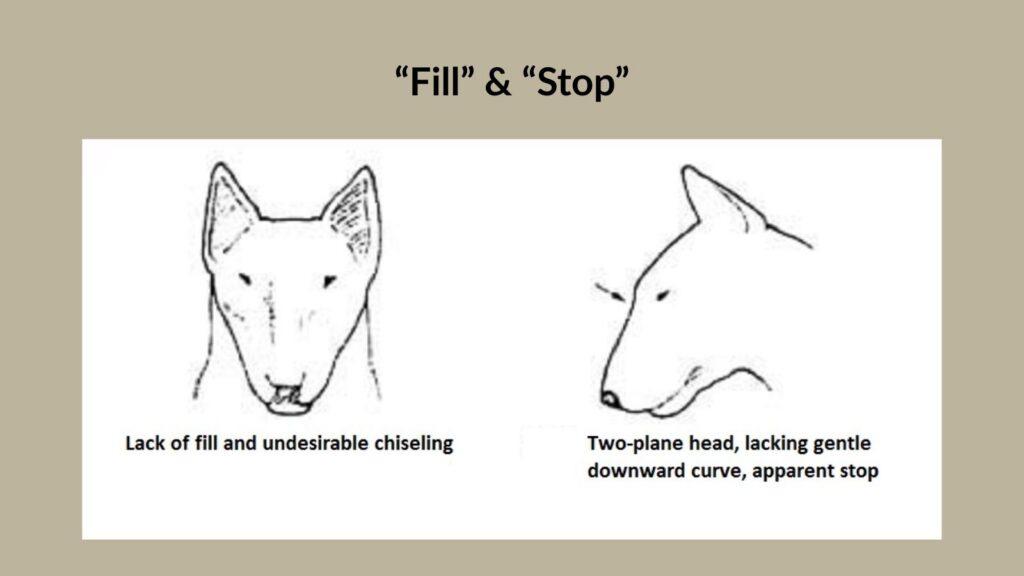
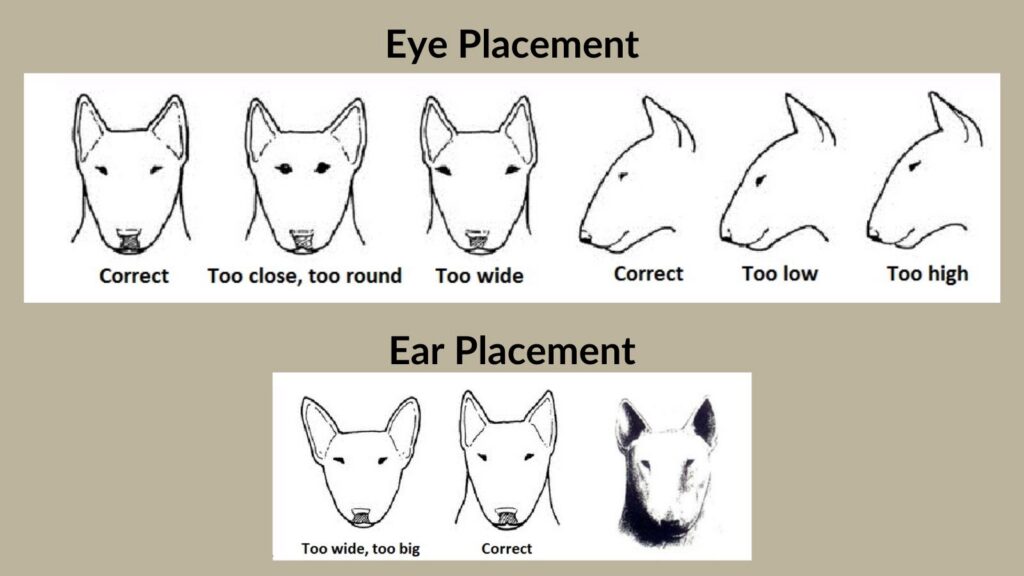
Head: The head should be long, strong and deep, right to the end of the muzzle, but not coarse. The full face should be oval in outline and be filled completely up, giving the impression of fullness with a surface devoid of hollows or indentations, i.e., egg shaped. The profile should curve gently downwards from the top of the skull to the tip of the nose. The top of the skull should be flat across from ear to ear. The distance from the tip of the nose to the eyes should be perceptibly greater than that from the eyes to the top of the skull. The underjaw should be deep and well defined. To achieve a keen, determined, and intelligent expression, the eyes should be well sunken and as dark as possible with a piercing glint. They should be small, dark, triangular and obliquely placed, set high up on the dog’s head, placed closer to the ears than to the nose. Blue eyes are a disqualification. The ears should be small, thin, and placed close together, capable of being held stiffly erect. The nose should be black, and bent downwards at the tip. The lips should be clean and tight. The teeth should meet in either a level or scissor bite with correctly placed canines. The teeth should be sound, strong and perfectly regular. While correct dentition is desirable, it should never be considered more important than the traits of the breed outlined in this standard.
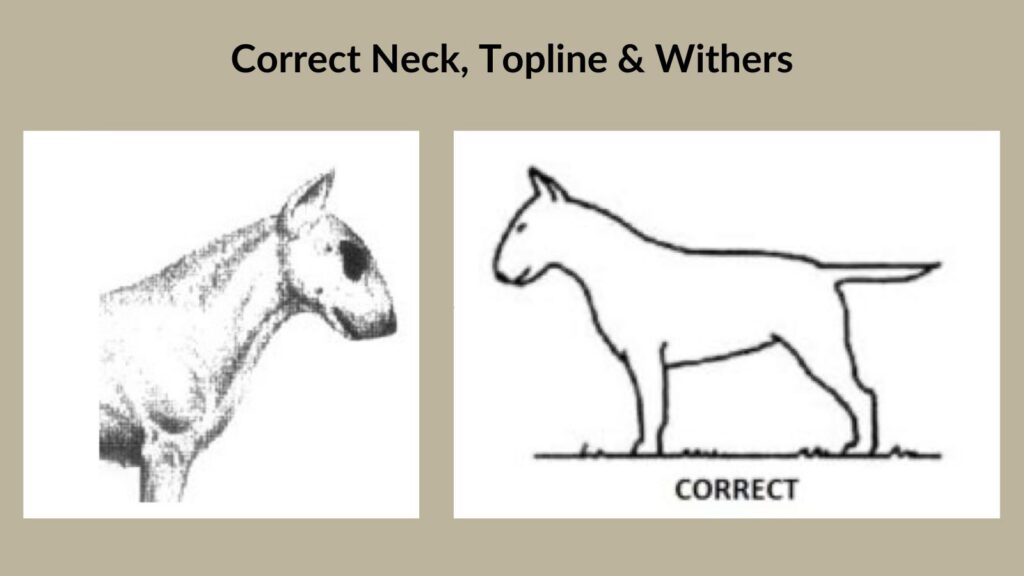
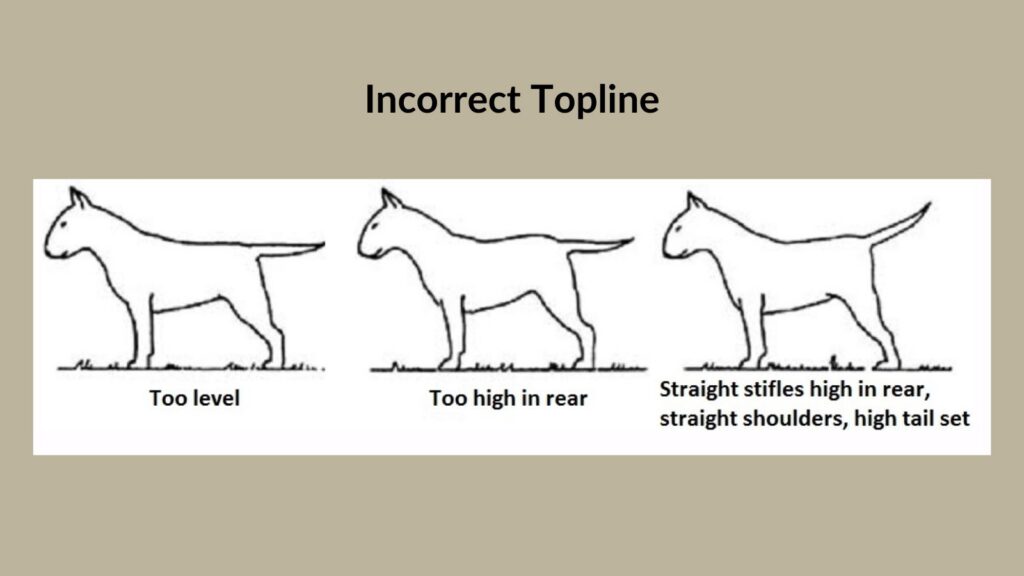
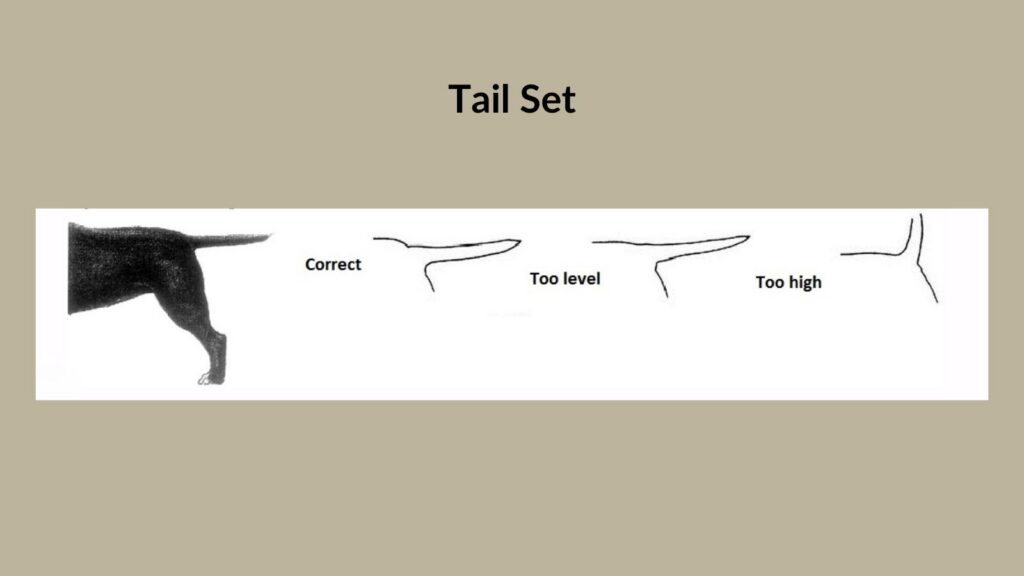
Neck, Topline, Body: The neck should be very muscular, long, and arched; tapering from the shoulders to the head, it should be free from loose skin. The back should be short and strong with a slight arch over the loin. Behind the shoulders there should be no slackness or dip at the withers. The body should be well rounded with marked spring of rib and short coupled. The chest should be broad when viewed from the front. There should be great depth from withers to brisket, so that the latter is nearer to the ground than the belly. The underline, from the brisket to the belly, should form a graceful upward curve. The tail should be short, set on just below topline, and carried horizontally. It should be thick where it joins the body and should taper to a fine point.
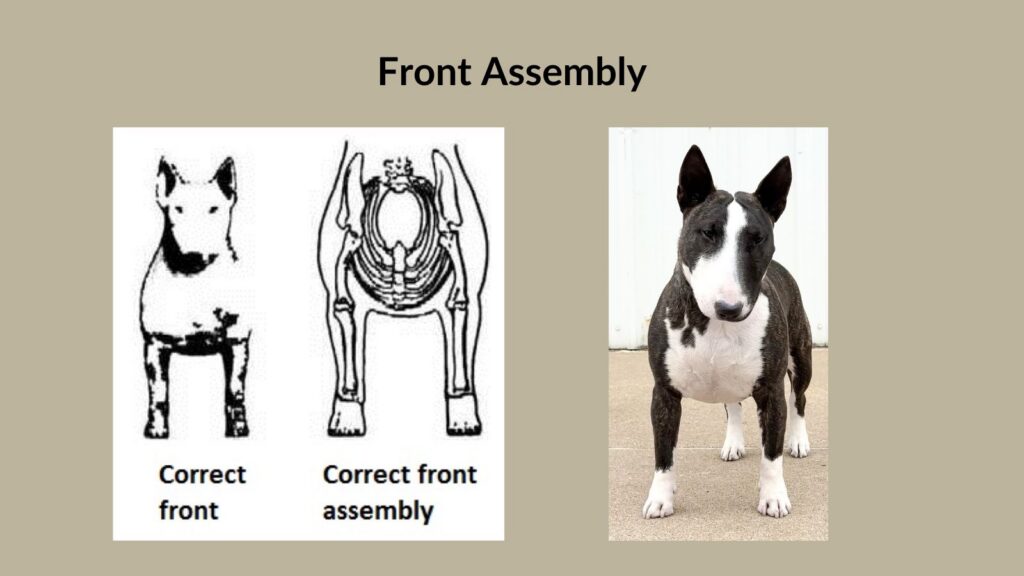
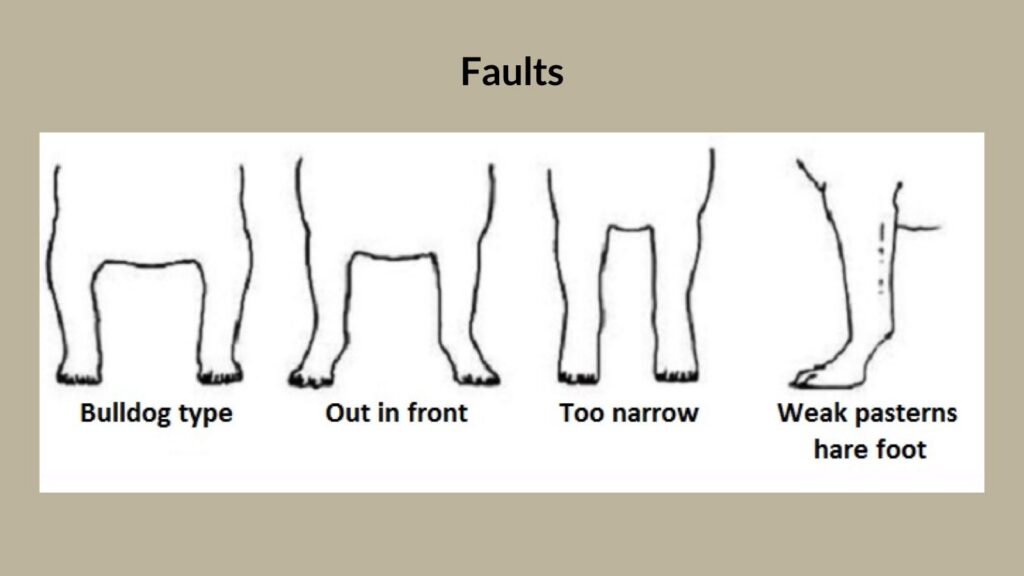
Forequarters: The shoulders should be strong and muscular, but without heaviness. The shoulder blades/scapula should be laid back and approximately the same length as the upper arm/humerus. When viewed from the side the elbow should be directly below the highest point of the shoulder. The legs should be big boned but not to the point of coarseness. The forelegs should be of moderate length, perfectly straight, and the dog must stand firmly upon them. The elbows must turn neither in nor out, and the pasterns should be strong and upright. The feet are round and compact with well-arched toes like a cat.
Hindquarters: The hind legs should be parallel when viewed from behind. The thigh and second thigh are very muscular and well-developed. The stifle joint and hock are well angulated with hind pasterns short and upright. The feet are round and compact with well arched toes like a cat.
Coat: The coat should be straight, short, flat and harsh to the touch with a fine gloss. The dog’s skin should fit tightly.
Color: For white, pure white coat. Markings on head and skin pigmentation are not to be penalized. For colored, any allowed color to predominate. Allowed colors: Brindle, Black Brindle, Black and Tan, Red, Fawn – With or without white and/or smut markings. Any other color is a disqualification.
Gait: The dog shall move smoothly, covering the ground with free, easy strides, Fore and hind legs should move parallel to each other when viewed from in front or behind, with the forelegs reaching out well and the hind legs moving smoothly at the hip and flexing well at the stifle and hock. The dog should move compactly and in one piece but with a typical jaunty air that suggests agility and power.
Temperament: The temperament should be full of fire and courageous, but even and amenable to discipline.
Faults: Any departure from the foregoing points shall be considered a fault, and the seriousness of the fault shall be in exact proportion to its degree.
Disqualifications:
Blue eyes.
Any color other than allowed.
Approved January 13, 2026
Effective April 1, 2026
A Note on Color and Coat
Prospective puppy buyers should be wary of breeders advertising “rare” or “exotic” colors such as Merle, Lilac, Chocolate, Liver, Isabella, or Lavender. You might even see “Fluffy” “Minis.” These colors are not part of the established Miniature Bull Terrier gene pool and are not recognized by the Breed Standard. Put simply: These are not Miniature Bull Terriers. They literally cannot be Minis.
Producing such colors and textures requires introducing genetic material from other breeds, placing color above breed preservation. Responsible preservation breeders prioritize health, temperament, structure, and breed type rather than novelty or market-driven trends.
Some of these dogs are sold with AKC papers, but that can only mean that the parents were registered illegally, and someone lied when registering them. Please do not support these unscrupulous breeders.
Exotic Colors Have Health Related Concerns
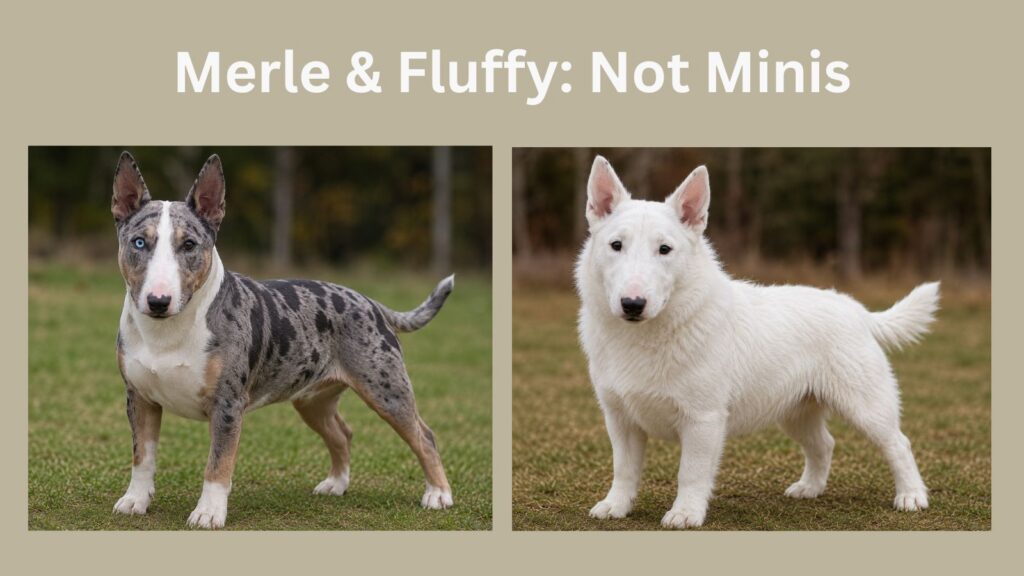
The dogs above were created by AI for demonstration purposes.
Beyond concerns about breed purity and preservation, some of the genes responsible for so-called “exotic” colors are associated with health risks. The Merle gene, for example, can cause serious problems when two Merle dogs are bred together, including deafness, vision defects, and other developmental abnormalities. Merle introduces a gene that has never been part of the traditional Miniature Bull Terrier gene pool.
Extreme dilution colors, often marketed as Lilac, Lavender, or Isabella, may also be associated with Color Dilution Alopecia (CDA), a condition that can cause hair thinning, patchy coat loss, and recurring skin problems. While not every dilute-colored dog develops CDA, the risk is well documented in several breeds where dilution genes are present.
These health concerns illustrate why responsible breeders focus on preserving the breed’s established colors and characteristics rather than pursuing novelty. The goal of preservation breeding is to produce healthy, sound Miniature Bull Terriers that conform to the Breed Standard, not to create rare colors that may compromise the breed’s long-term welfare.
Here is our cheat sheet:
- If a breeder uses the terms “exotic” or “rare,” steer clear.
- “Minis” advertised as the following ARE NOT PURE MINIATURE BULL TERRIERS, and in our opinion, should not be labeled and sold as MBTs.
- Merle (any Merle, such as Blue Merle, Red Merle, etc.)
- Blue
- Blue Fawn
- Liver
- Lilac
- Isabella
- Lavender
- Chocolate
- Tri-Merle or Tri-Merle combinations
- Platinum
- Champagne
- Fluffy, or any coat texture other than as described in the Breed Standard
- Note that unscrupulous breeders will try to sell you a “Mini” that is not only not a Mini but also charge exorbitant prices.
- A note on Recessive vs. Dominant genes: While it is theoretically possible for a recessive color gene to remain hidden for generations, there is no documented evidence that the liver (chocolate) gene was historically part of the Miniature Bull Terrier gene pool. Preservation Breeders generally regard liver as a non-traditional color whose appearance raises questions about the breed’s genetic history. Unlike recessive colors, the Merle gene is dominant and cannot remain hidden indefinitely, which is why claims that Merle has always existed in the breed are viewed with particular skepticism.
- We have seen language on websites such as the following. These descriptions represent a lack of understanding of the Miniature Bull Terrier, and we do not support this kind of breeding. This language is a strong cue to move on and find a reputable breeder, such as one listed on the MBTCA Breeder List.
- “Today, this color variety appeals to families seeking a dynamic companion with a distinctive appearance… This variation represents a modern aesthetic development bred primarily in the United States and Europe over recent decades.”
- “Eyes may even range from traditional brown to striking blue, adding an extra touch of distinction.”
Mini Bull Type
Here we have some drawings showing correct and incorrect Conformation. This is not just about a dog “looking good.” Poor Conformation – structure – can also lead to health issues, such as when you have weak pasterns or other skeletal issues.