
Let’s say this right up front: the safest toys for any dog are toys that are played with under supervision. That said, we know life gets in the way, and we want to believe that dogs can be okay with a toy on their own. Individual dogs have different chewing styles, and only you will know, through observation, what works for your puppy and dog.
If you live with a Miniature Bull Terrier, you already know that “dog toy” can be a very misleading term. Plenty of toys marketed for dogs are designed for average chewers, gentle Retrievers, or dogs who carry a plush around like a baby. That is not the Mini Bull Terrier job description.
Mini Bulls bite hard, chew with commitment, and often approach toys as a challenge rather than a pastime. A toy that survives a Spaniel may last five minutes with a determined bully puppy. And when a toy fails, the issue is not just the mess. It is the risk of swallowed fabric, squeakers, rope strands, rubber chunks, plastic pieces, or stuffing. Please read our article on Zipper Surgery.
So, when I talk about “bully-safe” toys, I do not mean indestructible, because no toy is truly indestructible. I mean toys that are appropriately sturdy, thoughtfully chosen, size-appropriate, and used with supervision and common sense. The goal is not to hand a puppy a random object and hope for the best. The goal is to give them safe outlets for chewing, carrying, chasing, and problem-solving without creating a veterinary emergency.
First, the Rule That Matters Most: Know Your Dog
There is no universal safe toy. There is only a toy that is appropriate for this dog, at this age, with this chewing style, in this situation.
A toy that is perfectly fine for one Mini Bull may be a terrible choice for another. Some dogs gnaw. Some peel and dissect. Some try to remove every seam and spit out the carcass. Some will happily carry a soft toy around for months, while their littermate will perform open-heart surgery on it in under ten minutes.
Mini Wisdom: Puppies also change quickly. What was safe at ten weeks may not be safe at six months. What was a supervised play toy may not be appropriate for unsupervised crate time. Owners have to pay attention to the dog in front of them, not just the label on the package.
My Basic Toy Safety Rules for Bullies
Before I get into categories, these are the standards I use in my own house:
1. Bigger is usually better
If you are deciding between two sizes, I generally lean larger. Tiny toys, miniature tennis balls, little squeaky plushies, and anything that can disappear fully into the mouth are poor choices for a bully breed puppy. I do not want toys that can be swallowed whole or torn into gulpable pieces quickly.
2. Retire damaged toys early
A toy does not need to be completely destroyed to become unsafe. If a seam opens, a squeaker is exposed, a rubber edge starts peeling off, or a nylon toy splinters into sharp points, it is done. Throw it away.
3. Separate “interactive toys” from “leave-alone toys”
Some toys are for tugging, fetching, and training sessions with you. Some are for supervised independent chewing. Very few toys should be treated as “drop this in the crate and forget about it.”
4. Rotation beats clutter
Most dogs do better with a smaller number of good toys rotated regularly than with a mountain of junky toys available all the time. Rotation keeps toys interesting and makes it easier for owners to notice wear and tear.
5. Supervision matters, especially with puppies
Puppies are creative in all the wrong ways. The first several times a new toy is offered, I want to see exactly how the puppy interacts with it. Does she chew appropriately? Try to swallow it? Shred it? Strip off pieces? Fall asleep with it? That tells me whether the toy stays in rotation or gets removed.
What I Like for Miniature Bull Terriers
Durable rubber toys for chewing and stuffing
This is one of my favorite categories for bully puppies and adults because it can do several jobs at once. A good heavy rubber toy, like the classic Kong, can satisfy chewing needs, slow down eating, occupy a busy brain, and help a puppy settle in a crate or x-pen.
These stuffable rubber toys that can be filled with part of a meal, a smear of something puppy-safe, or a few pieces of kibble. For many puppies, these become far more valuable than random plush toys because they reward licking, chewing, and working instead of frantic destruction.
What I like:
- Thick, reputable rubber from established dog-toy brands, like Kong
- More choices: WEST PAW Zogoflex Echo Zwig,
- Check out RuffDawg’s Dawg-Nut donut shapes and the Maxx and the Tastee Choo from Choobee.
- Shapes large enough that the dog cannot fit the entire toy deep into the back of the mouth
- Toys that can be stuffed, frozen, and washed easily
- Rubber that flexes slightly rather than feeling brittle or thin
What I avoid:
- Cheap rubber toys with a strong chemical smell
- Toys with glued-on decorations, plastic eyes, or weak seams
- Very small rubber toys sold for “small dogs” that are not appropriate for a bully jaw
Harder chew toys, used thoughtfully
Some bully owners do well with sturdy chew toys made of dense nylon, wood-alternative composites, or other hard materials. These can be useful for dogs who truly need to work their jaws. But I use more caution here than many people do.
A chew toy should not be so hard that I worry about teeth. There is a difference between durable and brick-like. Aggressive chewers can crack premolars and molars on items that are simply too hard. I also do not want sharp edges or splintering surfaces.
If I use harder chew toys, I inspect them constantly and match them to the dog’s chewing style. A dog who calmly gnaws may do well with them. A dog who slams down and tries to fracture the toy may not.
Mini Wisdom: I know that wood sounds like an off choice, but coffee wood dog toys work well in many Mini households. Also check out Nylabone and Benebone brands for good choices. You will quickly learn what shapes your dog likes; for some reason, Nora and her kids love the wishbone shapes!
Balls that are too large to swallow and tough enough for supervised play
Mini Bulls often love chase games, but ball choice matters. I do not like tiny tennis balls for bully puppies, and I am not a fan of flimsy squeaky balls that collapse into shards. I prefer balls that are:
- Appropriately oversized
- Made for strong chewers
- Smooth enough not to shred instantly
- Used under supervision, especially if the dog’s goal is to sit and methodically destroy the ball rather than retrieve it
A ball for fetch is not automatically a ball for unsupervised chewing.
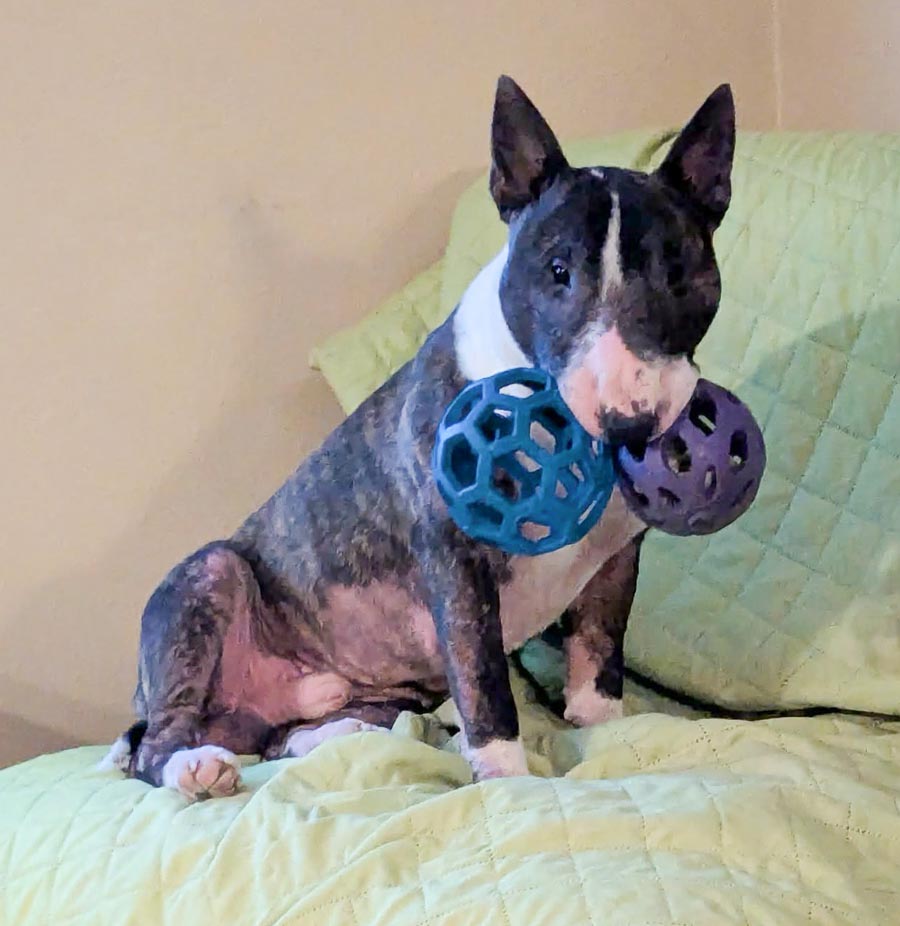
Check out: Chew King by Mammoth Fetch Ball and Jolly Ball. An exception in design is the JW Pet HOL-ee Roller™, Dog Toy Puzzle Ball, and the Petmate Crackle Heads Ball, which some dogs love. Funny story, I knew one dog who had a red HOL-ee Roller and a blue one. He went for the red one every single time.
Mini Wisdom: If you find that your dog is very ball-focused–and some are–beware that they may repeatedly nudge it around, which can lead to a banged-up nose area. Just keep an eye out for obsessive play and use.
Tug toys for interactive play
Tug is a wonderful outlet for many MBTs when it is done with structure. A sturdy tug toy can give a puppy an appropriate target for grabbing and pulling and can be a great way to channel intensity into a game with rules.
For tug toys, I look for:
- Durable construction
- Comfortable length so hands are not too close to teeth
- Materials that do not unravel immediately
But tug toys are people toys in my house, not toys I leave lying around all day for puppies to dissect. Be wary of ones made from rope or braided fleece. They can work, but only with supervision and get rid of them the moment they start to unravel.
Mini Wisdom: Look into Goughnuts Heavy-Duty Tug Toy.
Natural Bones
We love natural bones and there are a few that we recommend.
Firstly, if you have a high-quality butcher nearby and can buy marrow bones, they can be a great treat. I remove most of the marrow, as your dog does not need all that fat.
I also love the cold-smoked beef marrow bones by Mika & Sammy’s Gourmet Pet Treats.
Natural Hair-On Hide Rolls
Ugly Chews and Farm Hounds make hair-on natural hide rolls that are not the same as “rawhide” chews you might find in a pet store, which are heavily processed and often treated with harsh chemicals. The inexpensive, commercial type are made only from the inner layer of the hide, after the outer portion has been removed for leather production. The result is a chew that dogs can soften, tear apart, and swallow much more quickly, which can increase the risk of choking or intestinal blockage. These are different, but we still suggest use under supervision.
The first time you see the hair-on rolls, you might be a bit shocked, but most dogs love them and the hair is digestible and very beneficial to the digestive tract (think of it like a pipe cleaner). It also delivers good levels of fiber and manganese, according to Farm Hounds. They are also quite long lasting.
Mini Wisdom: Take the time to read the brands’ websites; they have a lot of information on how to choose size and how to safely offer them to your pup or dog.
Fleece or soft “stuffy” comfort items for the right puppy
This is where people sometimes expect a universal rule from me and do not get one. Some puppies are perfectly capable of having a soft comfort toy. Others absolutely cannot be trusted with one.
If a puppy gently carries a plush, naps with it, or mouths it without trying to excavate the stuffing, a soft toy may be fine as a supervised comfort item. If the puppy’s life mission is to remove the eyes, open the seams, and consume the squeaker, then no, that puppy does not get plush toys.
Mini Wisdom: I do not assume that because something is sold in the pet aisle it is safe for a bully puppy. Plush is a privilege, not a right.
Tires
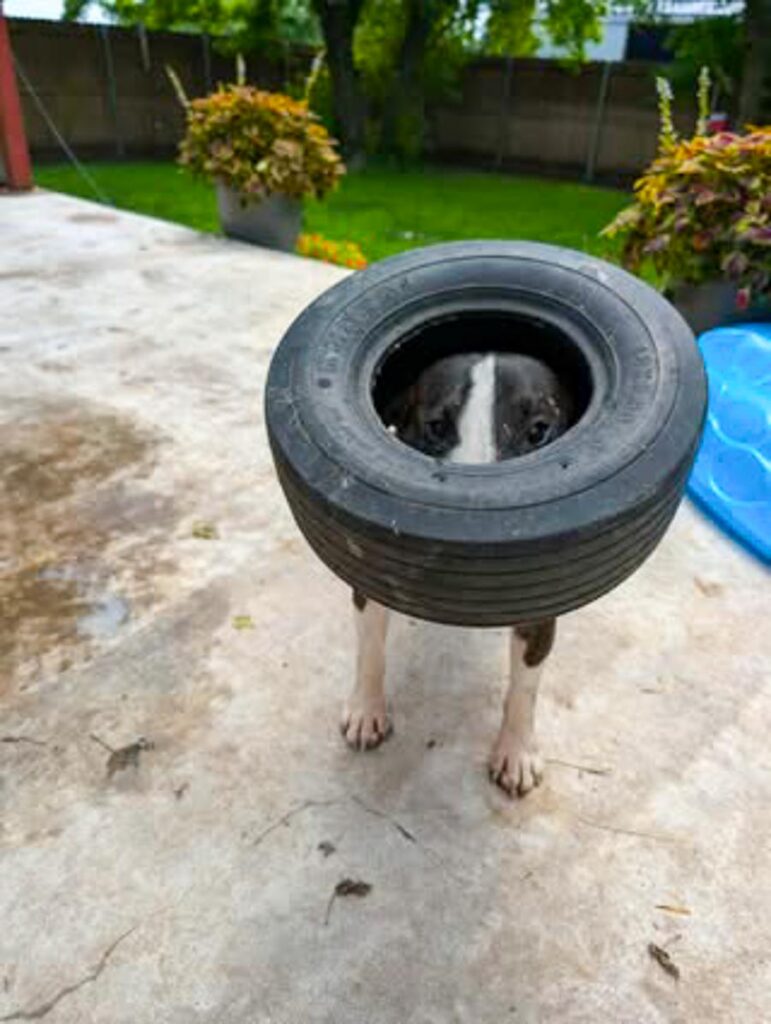
Yes, tires. Some folks use smaller tires as play/chew toys. Here you can see a lawn mower tire getting a workout.
What I Am Cautious About
Rope toys
Rope toys are extremely popular, and I understand why. Dogs love them. They are easy to throw, easy to tug, and often inexpensive. But for a dog who shreds and ingests fibers, rope makes me nervous.
Long strings swallowed from rope toys can create serious gastrointestinal problems. If I use rope at all, it is for closely supervised interaction, and I retire it the moment it begins to fray. I do not leave shredded rope toys in a crate and call it enrichment.
Antlers, bones, hooves, and ultra-hard natural chews
Some owners swear by these. I am more conservative. My concern is tooth damage, breakage, and in some cases digestive upset or gulping risks. Mini Bulls are enthusiastic enough without being handed a tooth-cracking project.
Toys with glued parts, plastic trim, or easy-to-remove accessories
If it has little ears, ribbons, hard plastic eyes, bells, pom-poms, or decorative nonsense, it is probably not coming into my house for a bully puppy. I want clean, simple construction.
Anything already half-destroyed
This sounds obvious, but people keep toys far longer than they should. A “favorite toy” with an open seam and stuffing hanging out is not sentimental. It is a problem.
Crate Toys Need Their Own Standards
Owners often ask what can go in the crate. My answer is: fewer things than you think.
Crate time is not the place for a pile of random toys. If I am leaving a puppy or dog with something, I want it to be something I know well, have already observed, and trust for that specific puppy/dog. Often that means a thoughtfully chosen rubber stuffable toy or, depending on the dog, nothing at all beyond safe bedding if bedding is appropriate for that puppy.
I do not recommend loading a crate with plush toys, rope toys, or anything a puppy has already shown an interest in shredding.
Mini Wisdom: I always run my hands through my dog’s crate bedding. They are known to take toys into their “den” and hide them for later, and it might be a toy I do not want them to have unsupervised.
Toy Safety Is Also About Teaching
One of the best things owners can do is actively teach toy habits instead of just tossing toys on the floor and hoping for the best.
Use toys to:
- Redirect biting onto appropriate objects
- Reward calm crate time
- Build retrieve and tug games with rules
- Create positive downtime after exercise
- Reinforce that hands, clothes, leashes, and crate bedding are not chew toys
Bullies do best when we do not leave them to invent their own entertainment.
My Bottom Line on Bully-Safe Toys
If you own a Miniature Bull Terrier, buy toys with a healthy amount of skepticism. Ignore cute marketing and think like a risk manager. Ask:
- Is it large enough?
- Is it durable enough for my dog?
- What happens if this starts to fail? Is there a choking or obstruction hazard?
- Can I supervise it appropriately?
- Is this a toy for active play, chewing, comfort, or crate time?
- Has my puppy already shown me she cannot be trusted with this type of material?
Mini Wisdom: There is no perfect toy. But there are much better choices and much worse ones.